Korean Skincare Ingredients For Nighttime: What Do They Actually Do?

Korean skincare is often associated with glowing skin, elaborate nighttime routines, and long ingredient lists.
When you look at the back of a Korean skincare product, you may encounter ingredients such as niacinamide, ceramides, hyaluronic acid, snail mucin, centella asiatica, peptides, fermented extracts, and adenosine, but it isn’t always obvious what they actually do.
Do you need all of them? Do certain ingredients work better at night? And does applying a particular ingredient before bed really help your skin “repair” itself while you sleep? The answer is more nuanced than many skincare trends suggest.
A nighttime skincare routine isn’t about finding one magical ingredient. It’s about choosing ingredients that address your skin’s needs while supporting hydration, the skin barrier, and specific concerns.
This guide explains some of the most common ingredients found in Korean nighttime skincare, what they are generally used for, how they fit into a routine, and what beginners should realistically expect from them.
Does Skincare Work Differently At Night?
Your skin doesn’t suddenly switch into a completely different biological system when the sun goes down.
However, nighttime provides a useful opportunity to focus your skincare routine on cleansing, hydration, barrier support, and targeted treatments without having to worry about daytime makeup, sunscreen layering, or immediate sun exposure.
Some active ingredients are also commonly used at night because they can increase sensitivity to sunlight or because nighttime is simply a convenient opportunity to use them consistently.
It’s therefore more useful to think of nighttime skincare as a supportive environment for your routine, rather than assuming that every ingredient becomes more powerful after dark.
In other words, many skincare ingredients aren’t inherently “nighttime ingredients.” They simply fit naturally into a nighttime routine. If you’re interested in the biology behind nighttime skin changes, see our article [Why Your Skin Repairs Itself While You Sleep (And How to Support It)].
Understanding Korean Skincare Ingredients By Function
There are hundreds of ingredients used in Korean skincare, and you don’t need to understand every chemical name on an ingredient list. For a beginner, it is much more useful to understand ingredients according to what they are generally intended to do.
Think of them in broad categories:
- Humectants help attract and hold water.
- Emollients help soften and condition the skin.
- Barrier-supporting ingredients help support the skin’s protective barrier.
- Soothing ingredients are commonly used in products designed for skin comfort.
- Antioxidants help protect formulations and skin from oxidative stress.
- Targeted active ingredients are used to address particular concerns.
- Exfoliating ingredients help remove or loosen dead skin cells at the surface.
Once you understand these basic functions, Korean skincare ingredient lists become much less intimidating.
Ingredients For Hydration
- Hyaluronic Acid: A Hydration-Focused Ingredient
Hyaluronic acid (HA) is one of the most familiar ingredients in modern skincare. It is a humectant, meaning it helps attract and hold water.
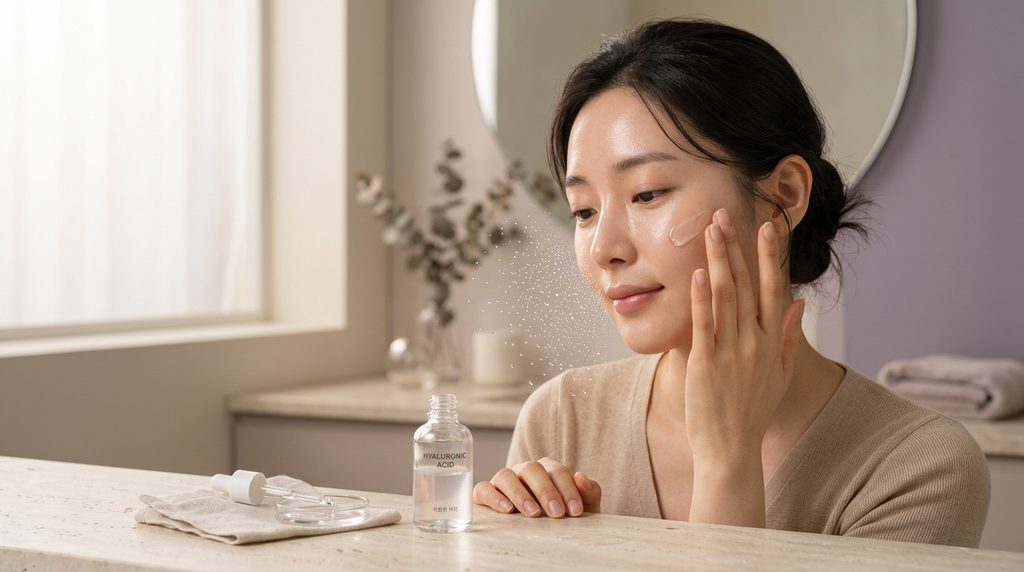
This is why it commonly appears in products such as:
- Toners
- Essences
- Serums
- Ampoules
- Moisturizers
- Sleeping masks
What can hyaluronic acid do?
Depending on the formulation, hyaluronic acid can help skin feel:
- More hydrated
- Softer
- Smoother
- Less tight
However, hyaluronic acid isn’t a complete moisturizer by itself. A hydrating serum containing HA is generally used as part of a broader routine, often followed by a moisturizer or another product that helps reduce moisture loss.
Is hyaluronic acid specifically a nighttime ingredient?
Not really. Hyaluronic acid can generally be used in either a morning or nighttime routine. Its popularity in nighttime skincare comes largely from its ability to complement a hydration-focused routine.
- Panthenol: Hydration And Skin Comfort
Panthenol, also known as provitamin B5, is widely used in skincare. It has humectant and skin-conditioning properties and is commonly included in products designed to moisturize and soothe the skin.
You may find panthenol in:
- Serums
- Essences
- Creams
- Cleansers
- Sleeping masks
Because panthenol tends to be used as a supportive ingredient rather than an aggressive active, it can fit naturally into a simple nighttime routine. For beginners, it is useful to recognize panthenol as an ingredient that can contribute to hydration and skin comfort.
Ingredients For Skin-Barrier Support
- Ceramides: Supporting The Skin Barrier
Ceramides are lipids naturally found in the outer layer of the skin. A useful way to think about the skin barrier is as a protective structure that helps keep moisture in while helping protect the skin from external irritants.
Ceramides are one important component of that barrier. Skincare products containing ceramides are commonly used in routines designed to support dry or compromised skin.
What can ceramides help with?
They may help the skin:
- Retain moisture
- Feel less dry
- Maintain barrier function
- Feel more comfortable when the barrier is weakened
Ceramides can be particularly useful in nighttime moisturizers because they complement routines focused on maintaining hydration and reducing moisture loss.
Who might benefit?
Ceramides can be useful for many skin types, but they may be particularly relevant if your skin tends to be:
- Dry
- Easily irritated
- Rough
- Dehydrated
- Sensitive to over-cleansing
And they don’t need to be reserved for nighttime.
- Squalane: Lightweight Emollient Support
Squalane is an emollient used to soften and condition the skin. It can also contribute to the feel and moisturizing properties of skincare formulations. Unlike some heavier oils, squalane is often formulated into relatively lightweight products.
It can appear in:
- Serums
- Moisturizers
- Facial oils
- Night creams
If your skin is dry or feels uncomfortable after cleansing, a formula containing an emollient such as squalane may provide additional comfort. Again, the ingredient itself is only part of the picture. The overall formulation and your individual skin response matter too.
Centella Asiatica: Soothing And Skin Support
- Centella Asiatica: Soothing And Skin Support
Centella asiatica, often called cica, is another major ingredient associated with Korean skincare. It is particularly popular in products designed for skin that feels irritated, stressed, or sensitive. Centella contains several compounds, including asiaticoside and madecassoside, that have been studied for their potential effects on skin.
Why is centella popular in nighttime skincare?
Nighttime routines often emphasize comfort, hydration, and barrier support. A soothing ingredient such as centella can therefore fit naturally into routines designed to support comfortable-looking skin rather than aggressively exfoliate it.
You may find centella in:
- Toners
- Ampoules
- Serums
- Creams
- Masks
- Sleeping masks
For beginners, centella can be an ingredient worth looking for when your priority is a simple, comfort-focused routine.
- Green Tea: Antioxidant And Soothing Support
Green tea extract, often listed as Camellia sinensis leaf extract, is another common Korean skincare ingredient. Green tea contains polyphenols, including catechins, which have antioxidant properties.
In skincare, green tea is commonly included in formulations designed to provide antioxidant and soothing benefits. It isn’t exclusively a nighttime ingredient, but it can complement a nighttime routine focused on maintaining healthy-looking skin.
- Snail Mucin: Hydration And Conditioning
Snail mucin is one of the most recognizable ingredients associated with Korean skincare. It is derived from snail secretion filtrate and is commonly used in essences, serums, and creams. The exact composition can vary by product, but snail-derived ingredients can contain a mixture of compounds associated with hydration and skin conditioning.
What does snail mucin do?
In skincare products, it is commonly used to help:
- Hydrate the skin
- Improve the feeling of smoothness
- Condition the skin
- Support a more supple appearance
Snail mucin isn’t a magical overnight repair treatment, however. Its value depends on the overall formulation and how your individual skin responds.
Is snail mucin suitable for everyone?
Not necessarily. If you experience irritation or a suspected sensitivity to a product, discontinue use rather than assuming that a popular ingredient will automatically suit your skin.
Ingredients For Specific Skin Concerns
- Niacinamide: A Versatile Ingredient
Niacinamide, a form of vitamin B3, is one of the most versatile ingredients commonly found in Korean skincare. It can appear in everything from toners and essences to serums and moisturizers.
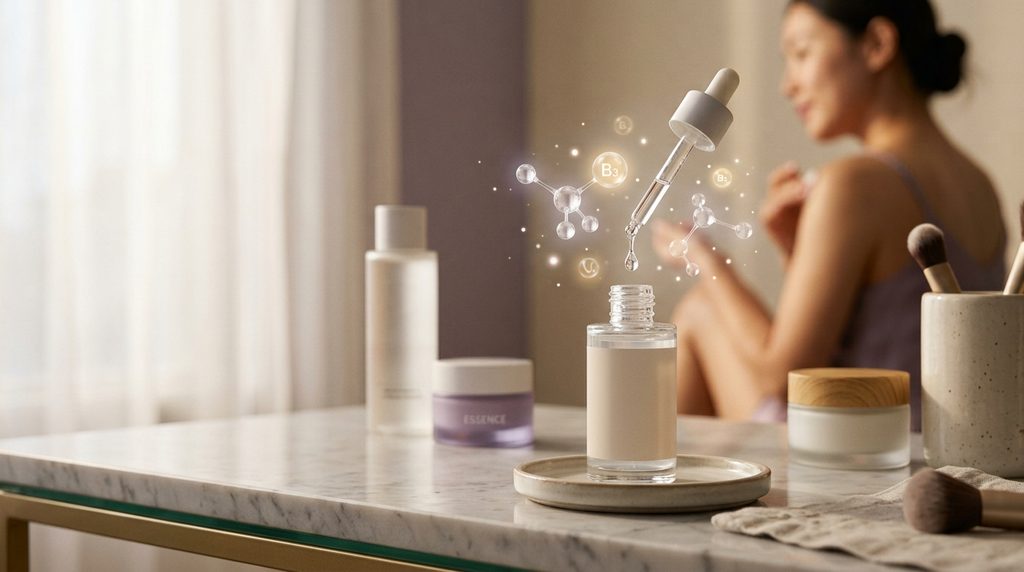
Depending on the formulation and concentration, niacinamide is commonly used to support:
- The skin barrier
- The appearance of uneven skin tone
- Oil balance
- The appearance of pores
- Overall skin texture
Because of its versatility, you may encounter niacinamide repeatedly when looking at Korean skincare products.
Does niacinamide work better at night?
There is no simple rule saying that it must be used at night. Niacinamide can generally be incorporated into either a morning or evening routine. Its usefulness at night comes mainly from the fact that it can fit naturally into a routine where you’re already applying your treatment and moisturizing products.
- Peptides: Supporting The Appearance Of Aging Skin
Peptides are short chains of amino acids. In skincare, different peptides are used for different purposes, so they shouldn’t all be treated as if they work in exactly the same way. Some cosmetic peptides are formulated to support the appearance of firmer, smoother, or more youthful-looking skin.
What should you realistically expect?
Peptides are not instant wrinkle erasers. It is more useful to think of them as supportive ingredients within a consistent skincare routine.
If you’re concerned about visible signs of aging, consistency matters much more than applying a peptide product occasionally. This is one reason a nighttime routine can be useful: it provides a regular opportunity to apply your chosen treatment.
- Adenosine: An Ingredient Used In Anti-Aging Formulations
Adenosine appears in a number of Korean skincare formulations, particularly products marketed toward visible signs of aging.
It is commonly used in formulations intended to support the appearance of:
- Fine lines
- Smoother-looking skin
- More youthful-looking skin
Adenosine is often combined with other ingredients rather than used as the sole active ingredient. This illustrates an important principle: Skincare results usually depend on the overall formulation, not simply one impressive-sounding ingredient.
Fermented Ingredients In Korean Skincare
- Fermented Ingredients: More Than Just A Trend
Fermentation is an important theme in Korean skincare.
You may encounter ingredients such as:
- Fermented yeast
- Fermented botanical extracts
- Galactomyces ferment filtrate
- Bifida ferment lysate
- Rice ferment
- Other fermented plant or microbial-derived ingredients
Why are fermented ingredients used?
Fermentation can alter the composition of an ingredient and may produce different compounds or metabolites that can be useful in cosmetic formulations. However, “fermented” doesn’t automatically mean “better.” The actual ingredient, formulation, stability, concentration where relevant, and your skin’s response still matter.
Why are fermented ingredients common in nighttime products?
Many Korean nighttime products combine fermented ingredients with hydrating and conditioning ingredients as part of formulas designed for longer overnight routines. For a beginner, the important takeaway is not to choose a product simply because the word “fermented” appears on the packaging. Look at what the complete formulation is intended to do.
- Rice And Rice-Derived Ingredients
Rice has a long history in Korean beauty traditions and is now found in many modern skincare formulations.
Rice-derived ingredients can appear in:
- Cleansers
- Toners
- Essences
- Serums
- Masks
- Creams
Depending on the specific ingredient and formulation, rice-derived ingredients may be used for hydration, conditioning, brightening the appearance of skin, or supporting a smoother-looking complexion.
But the word “rice” on the front of a package doesn’t tell you everything about the product. The full ingredient list and the product’s intended purpose are more useful when deciding whether it belongs in your routine.
Stronger Active Ingredients
- Retinoids: Powerful But Not Uniquely Korean
Retinoids aren’t specifically Korean skincare ingredients, but they can appear in Korean nighttime products and deserve a place in this discussion. Retinoids are derivatives of vitamin A and are among the better-established topical ingredients for addressing visible signs of skin aging and certain other skin concerns.
However, they can also be more irritating than basic hydrating ingredients.
If you’re a beginner
Don’t introduce a retinoid at the same time as several other strong active ingredients. Start slowly and follow the product’s instructions. Some retinoid products can increase sensitivity to sunlight, which is another reason appropriate daytime sun protection is important.
Retinoids are a good example of why a nighttime skincare routine shouldn’t simply be built around adding as many “active” ingredients as possible.
- AHAs, BHAs And PHAs: Exfoliating Ingredients
Chemical exfoliants can also appear in Korean skincare products.
AHAs
Alpha hydroxy acids, such as glycolic acid and lactic acid, primarily work on the skin’s surface and can help improve the appearance of texture and dullness.
BHAs
Salicylic acid is the best-known beta hydroxy acid. It is commonly used in products intended for oily or blemish-prone skin because of its ability to work within oil-rich environments.
PHAs
Polyhydroxy acids are generally larger molecules than AHAs and are often incorporated into gentler exfoliating formulations.
Do you need them at night?
Not necessarily.
However, exfoliating products are often incorporated into nighttime routines because they can be easier to manage when you’re not immediately applying makeup or dealing with daytime sun exposure.
**Beginners should introduce exfoliating acids carefully rather than using several exfoliating products simultaneously.
Which Ingredients Might Be Useful For Different Skin Goals?
There isn’t one universally “best” Korean skincare ingredient. The better question is: What does your skin need?
Here’s a simple way to think about it:
| Skin goal | Ingredients to consider |
|---|---|
| Hydration | Hyaluronic acid, panthenol, glycerin |
| Barrier support | Ceramides, panthenol, squalane |
| Soothing | Centella asiatica, green tea, panthenol |
| Uneven-looking skin tone | Niacinamide, vitamin C derivatives, selected brightening ingredients |
| Visible signs of aging | Retinoids, peptides, adenosine, niacinamide |
| Texture | AHAs, BHAs, PHAs, retinoids |
| Dryness | Ceramides, squalane, humectants, emollients |
| General conditioning | Snail mucin, fermented ingredients, botanical extracts |
**This table is a starting framework, not a prescription or guarantee of results. Ingredient performance can depend on the formulation, concentration, stability, frequency of use, and individual skin response.
Do You Need Multiple Active Ingredients?
Usually, no. This is particularly important for beginners. You might see a product containing ten, twenty, or even more ingredients and assume that more ingredients mean a more powerful product.
That’s not necessarily true. A well-formulated moisturizer containing barrier-supporting ingredients and humectants may be far more useful to dry skin than a complicated collection of highly active products.
Similarly, someone concerned about uneven-looking skin tone doesn’t necessarily need several different brightening serums.
Start With One Main Concern
Dry skin:
Cleanser → Hydrating product → Ceramide moisturizer
Uneven-looking skin tone:
Cleanser → Niacinamide treatment → Moisturizer
Texture concerns:
Cleanser → Appropriate exfoliant → Moisturizer
Visible signs of aging:
Cleanser → Suitable treatment → Moisturizer
Once your skin is comfortable with the routine, you can consider whether additional products are actually necessary.
Ingredient Pairings: How Different Ingredients Can Complement Each Other
Some ingredients can complement each other because they serve different functions.
- Hyaluronic Acid + Ceramides
This is a useful hydration-focused combination. A humectant such as hyaluronic acid helps attract and hold water, while a moisturizer containing barrier-supporting ingredients such as ceramides can help reduce moisture loss. The two therefore serve different but complementary roles.
- Niacinamide + Ceramides
These ingredients can work well together in a barrier-focused routine. Niacinamide can be used for several common skincare concerns, while ceramides help support the skin barrier.
- Panthenol + Ceramides
This can be a useful combination for a simple, comfort-focused routine. Panthenol contributes hydration and conditioning, while ceramides support the skin barrier.
- Centella + Panthenol
Both are commonly used in products designed around soothing and skin conditioning.
- Peptides + Hydrating Ingredients
A peptide treatment can be incorporated into a routine that also includes basic hydration and moisturization. The important point is that ingredient compatibility isn’t the only consideration. Your skin’s tolerance matters just as much.
Ingredients Beginners Should Combine Carefully
Beginners should be particularly cautious when combining several potentially irritating active ingredients. For example, using multiple exfoliating acids alongside a retinoid may be unnecessarily harsh for some people.
Similarly, adding several strong treatments at the same time makes it difficult to determine which product is responsible if irritation occurs.
A more sensible approach is: Introduce → Observe → Adjust → Then add another product if necessary.
You don’t need to use every active ingredient every night. A simpler routine can also make it much easier to understand how your skin responds.
What About Fragrance And Essential Oils?
“Korean skincare” does not automatically mean fragrance-free. Some Korean products contain fragrance or essential oils such as lavender, citrus oils, bergamot, or other aromatic ingredients.
These may be acceptable for many people, but those with sensitive or reactive skin may prefer simpler formulations. This is particularly relevant when using several leave-on products at night.
Instead of assuming a product is gentle because it comes from a Korean skincare brand, check the ingredient list and consider how your own skin responds.
Why The Ingredient List Doesn’t Tell The Whole Story
This is one of the most important things beginners should understand. Two products can contain the same headline ingredient and still perform differently. Why? Because the ingredient is only one part of the formulation.
Other factors can include:
- Concentration
- Formulation
- Delivery system
- pH, where relevant
- Stability
- Supporting ingredients
- How frequently the product is used
- How the individual skin responds
For example, seeing niacinamide on two different product labels doesn’t mean the products will feel or perform identically. Likewise, a product with a long ingredient list isn’t automatically better than one with a short ingredient list.
Instead of asking:
“How many impressive ingredients does this product contain?”
Ask:
“What is this product formulated to do, and does it make sense for my skin?”
That is a much more useful way to evaluate skincare.
How To Read A Korean Skincare Ingredient List
Don’t be intimidated by the long list of unfamiliar chemical names. Start by looking for ingredients that relate to your particular goal.
For hydration, you might look for ingredients such as: Hyaluronic acid, glycerin, panthenol and other humectants.
For barrier support: Ceramides, fatty acids, cholesterol and supportive emollients.
For uneven-looking skin tone: Niacinamide and other ingredients formulated for that purpose.
For exfoliation: AHAs, BHAs or PHAs.
For visible signs of aging: Retinoids, peptides, niacinamide or adenosine, depending on the formulation.
But remember that the ingredient list doesn’t tell you everything. The concentration, delivery system, pH, formulation stability, and combination of ingredients can all influence how a product performs.
Don’t Chase Ingredients Just Because They’re Trending
Korean skincare trends change quickly. One year it may be snail mucin. Another year it may be rice, fermented ingredients, cica, probiotics, or another emerging ingredient. Trends can be useful for discovering new products and formulations, but they shouldn’t determine your entire skincare routine.
Instead, ask: What problem am I trying to address?
Then look for a product whose formulation is designed around that goal. This approach can save you money and prevent your nighttime routine from becoming unnecessarily complicated.
Where Do Ingredients Fit Into A Korean Night Routine?
Once you understand what individual ingredients do, the next question is how they fit into your actual routine.
A simple routine generally follows this progression:
Cleanser
↓
Toner or Essence
↓
Serum or Ampoule
↓
Moisturizer
↓
Sleeping Mask — Optional
Not every routine needs every step. For a beginner-friendly explanation of the overall sequence, see our guide to [Korean Night Skincare Routine for Beginners: A Simple Step-by-Step Guide].
Where Does A Sleeping Mask Fit?
Sleeping masks are generally used toward the end of a nighttime routine. They can provide an additional layer of hydration or conditioning while you sleep. However, a sleeping mask isn’t simply a container for “nighttime ingredients.”
Its formula determines what it actually does. Some emphasize hydration, some barrier support, while others contain ingredients designed to target particular skin concerns.
If you’re interested in incorporating one into your routine, our guide [How to Use a Korean Sleeping Mask: A Step-by-Step Night Routine] explains how to apply one and how frequently to use it.
Does “Night Repair” Mean Your Skin Repairs Itself?
This is an important distinction when reading skincare marketing.
You will often see Korean skincare products described with words such as:
- Repair
- Renew
- Regenerate
- Rejuvenate
- Overnight recovery
These terms can describe a product’s intended cosmetic benefits, but they shouldn’t automatically be interpreted as literal medical claims.
A skincare product can help hydrate, condition, smooth, brighten the appearance of, or support the skin barrier without literally repairing all tissue damage overnight.
For example, an overnight moisturizer may reduce the feeling of dryness and improve the appearance of your skin by morning. That doesn’t mean it has magically reversed every form of skin damage while you slept.
This distinction is particularly important when evaluating products marketed as overnight ampoules, sleeping masks, or “night repair” treatments.
A Simple Ingredient-Based Routine For Beginners
If you’re completely new to Korean skincare, start with the basics rather than trying to use every ingredient mentioned in this article.
- For Hydration
Cleanser → Hydrating serum → Moisturizer
Look for ingredients such as hyaluronic acid or panthenol if they suit your skin.
- For Barrier Support
Gentle cleanser → Hydrating essence → Ceramide moisturizer
This keeps the routine relatively simple while focusing on hydration and barrier support.
- For Uneven-Looking Skin Tone
Cleanser → Niacinamide treatment → Moisturizer
You don’t need several brightening products simply because they contain different ingredients.
- For Visible Signs of Aging
Cleanser → Suitable treatment → Moisturizer
The appropriate treatment will depend on your skin and the formulation.
** If you want to introduce a retinoid or exfoliating acid, consider adding it separately rather than changing your entire routine at once.
The Most Important Ingredient Is Consistency
There is no single Korean skincare ingredient that can replace a good overall routine.
Even well-established ingredients won’t be particularly useful if you use them inconsistently, constantly irritate your skin, or neglect basic daytime sun protection.
A sensible skincare routine usually has four foundations:
- Cleanse appropriately.
- Keep the skin hydrated.
- Use targeted ingredients when you actually need them.
- Protect your skin from UV exposure during the day.
- Everything else is optional refinement.
You don’t need to chase every new ingredient or add another serum every time a skincare trend appears.
Frequently Asked Questions
- What is the best Korean skincare ingredient to use at night?
There isn’t one best ingredient for everyone. For hydration, ingredients such as hyaluronic acid and panthenol can be useful. For barrier support, ceramides are important. For specific concerns, ingredients such as niacinamide, peptides, retinoids, or exfoliating acids may be appropriate depending on your skin and the particular formulation. The best choice depends on what your skin actually needs.
- Is Korean skincare better at night?
Korean skincare isn’t inherently more effective at night. Many Korean skincare products can be used either morning or evening. Nighttime simply provides an opportunity to focus on cleansing, hydration, barrier support, and selected treatments without having to layer daytime products such as sunscreen over them.
- What ingredients should beginners start with?
Start with relatively straightforward categories such as hydrating ingredients, moisturizers, and barrier-supporting ingredients. Once your basic routine is comfortable, you can introduce targeted active ingredients gradually if you have a specific concern you want to address.
- Can I use niacinamide and hyaluronic acid together?
Generally, yes. They serve different functions and are commonly included together in skincare formulations. Hyaluronic acid is primarily associated with hydration, while niacinamide has several potential skincare uses depending on the formulation and concentration.
- Can I use a sleeping mask with a serum?
Usually, yes. A sleeping mask is commonly applied near the end of the routine, after lighter treatment products. However, always follow the instructions for the specific sleeping mask because formulations can differ.
- Are fermented ingredients better than non-fermented ingredients?
Not automatically. Fermentation can change an ingredient’s composition and may offer formulation or skin-conditioning benefits, but the overall formulation matters more than the word “fermented” on the label.
- Do Korean skincare ingredients really repair skin overnight?
Some skincare products can support hydration, barrier function, and the appearance of healthier skin while you sleep. However, marketing terms such as “repair” or “renewal” shouldn’t automatically be interpreted as meaning that a cosmetic product literally repairs all skin damage overnight.
Final Thoughts
Understanding Korean skincare becomes much easier once you stop looking at products as mysterious bottles and start looking at them according to what their ingredients are designed to do.
- Hyaluronic acid can help with hydration.
- Ceramides support the skin barrier.
- Niacinamide is a versatile ingredient used for several common skincare concerns.
- Centella and panthenol can be useful in soothing and comfort-focused routines.
- Peptides and adenosine are commonly used in products targeting visible signs of aging.
Fermented ingredients are a distinctive feature of many Korean formulations, but “fermented” doesn’t automatically mean better. And stronger ingredients such as retinoids and exfoliating acids need more thoughtful introduction.
The best nighttime routine isn’t the one containing the most ingredients. It’s the one that gives your skin what it needs without unnecessarily irritating it and that you can maintain consistently.
Once you understand the role of individual ingredients, choosing Korean skincare becomes much less about following trends and much more about making informed decisions for your own skin.