Sleeping Mask vs. Night Cream: What’s the Difference and Which One Do You Need?

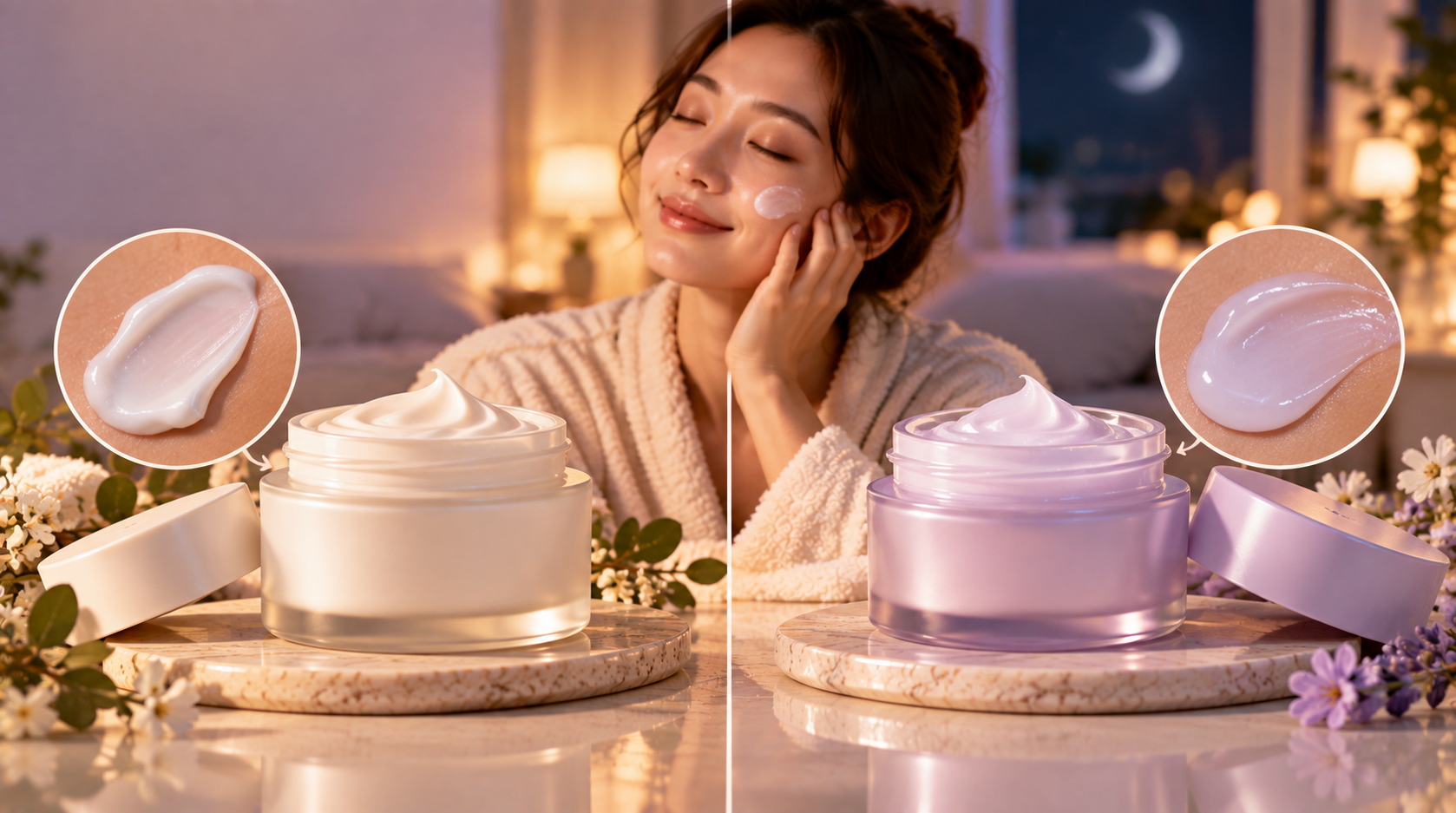
Sleeping masks and night creams can look surprisingly similar. Both are used at night, both can provide hydration, and both may contain ingredients designed to support the skin barrier or address specific concerns.
So if you already have a good night cream or moisturizer, do you actually need a sleeping mask? Probably not.
A sleeping mask can be useful when you want additional overnight hydration or targeted care, but it isn’t automatically a better or more effective version of a night cream. The main difference is usually how the product is formulated and intended to be used, rather than the name printed on the jar.
Sleeping Mask vs. Night Cream: At A Glance
| Night Cream | Sleeping Mask | |
|---|---|---|
| Main role | Regular nighttime moisturization | Optional overnight care or additional hydration |
| Typical use | Often used regularly | Often used occasionally, depending on the product |
| Texture | Cream, lotion, balm or gel-cream | Gel, gel-cream, cream or balm-cream |
| Main focus | Moisture retention and barrier support | Hydration, soothing or targeted overnight care |
| Essential? | Usually useful as a moisturizer | Usually optional |
| Can replace moisturizer? | It is the moisturizer step | Sometimes, depending on the formulation |
| Can be layered? | Sometimes followed by a sleeping mask | Some are designed to go over moisturizer |
These are general categories rather than strict definitions. Some sleeping masks function very much like moisturizers, while some are specifically designed to be applied over your existing cream.
For example, Laneige’s Water Sleeping Mask is instructed for use after moisturizer, while its Cica Sleeping Mask can be used either instead of cream or over cream, depending on the routine. Always check the specific product instructions.
What Is A Night Cream?
A night cream is essentially a moisturizer designed or marketed for nighttime use.
It may be richer than a daytime moisturizer, although this isn’t always the case. Depending on the formulation, a night cream can contain ingredients such as:
- Ceramides
- Glycerin
- Hyaluronic acid
- Squalane
- Panthenol
- Peptides
- Niacinamide
- Emollients and occlusives
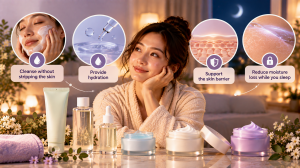
Its primary job is to help maintain moisture, reduce water loss and support the skin barrier while you sleep. Some night creams also contain treatment ingredients for concerns such as dryness, uneven skin tone or visible signs of aging. The important point is that the formulation matters more than the words “night cream” on the label.
What Is A Sleeping Mask?
A sleeping mask is a leave-on nighttime skincare product designed to remain on the skin while you sleep. Unlike a traditional wash-off face mask, you generally don’t rinse it off before going to bed.
Sleeping masks can be formulated as:
- Lightweight gels
- Gel-creams
- Creams
- Balm-creams
They are commonly positioned around overnight hydration, soothing, moisture retention or targeted skincare. The texture can vary considerably. A sleeping mask isn’t necessarily thick, just as a night cream isn’t necessarily heavy. That’s why comparing the actual formulation is more useful than assuming what a product will feel like based on its category.
The Key Difference: Regular Moisturizer vs. Optional Overnight Care
The simplest way to think about the difference is this:
- Night cream = your regular nighttime moisturizer.
- Sleeping mask = an optional overnight product that may provide additional hydration or targeted care.
However, there is considerable overlap between the two. A sleeping mask may contain many of the same types of moisturizing and barrier-supporting ingredients found in a night cream.
The distinction is often about intended use, formulation and product instructions, rather than two completely separate types of skincare science. And a sleeping mask isn’t automatically more hydrating simply because it is called a “mask.”
Can A Sleeping Mask Replace Night Cream?
Sometimes. It depends entirely on the product. Some sleeping masks are designed to be the final moisturizing step and can therefore replace a night cream. Others are specifically designed to be applied after your moisturizer.
For example:
If the product says to use it after moisturizer
Cleanser → Treatment → Moisturizer → Sleeping Mask
If the product is designed to replace moisturizer
Cleanser → Treatment → Sleeping Mask
There isn’t a universal rule that every sleeping mask must go over night cream. The manufacturer’s instructions should take priority.
Do You Need Both?
For most people, no.
If your current moisturizer keeps your skin comfortable and hydrated throughout the night, adding a sleeping mask may not provide enough additional benefit to justify another product.
A sleeping mask may be worth considering if:
- Your skin regularly feels dry or dehydrated.
- You want additional overnight hydration.
- Your current moisturizer isn’t quite enough.
- You enjoy occasional overnight treatments.
- The particular sleeping mask offers a function your existing routine doesn’t provide.
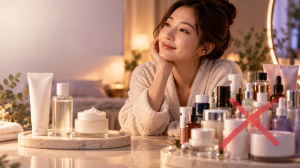
But if your moisturizer already works well, there is no requirement to add another layer simply because sleeping masks are popular. A simple routine that works consistently is often more useful than a complicated routine full of overlapping products.
- Dry Skin
Dry skin may benefit from either a suitable night cream or sleeping mask.
Start with a moisturizer that provides sufficient moisture and contains ingredients such as:
- Ceramides
- Glycerin
- Hyaluronic acid
- Panthenol
- Squalane
- Beta-glucan
- Other suitable emollients
If your skin still feels dry despite using an appropriate moisturizer, a sleeping mask may provide an additional overnight moisture layer. But don’t assume the sleeping mask is automatically the better option. A better-formulated moisturizer may solve the problem just as effectively.
- Oily Skin
Oily skin can still become dehydrated, but that doesn’t mean you need a sleeping mask. A lightweight moisturizer or gel-cream may be sufficient.
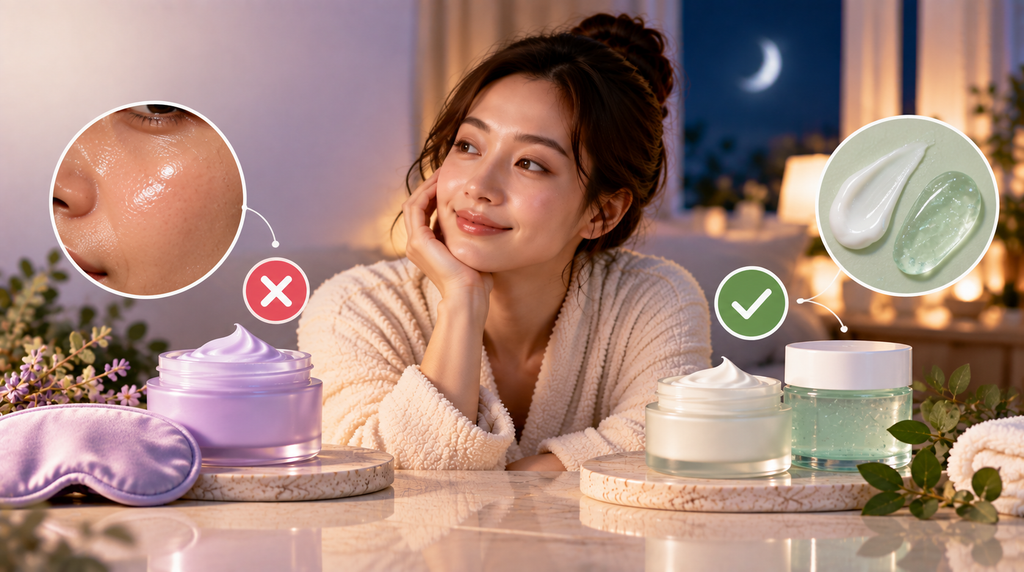
If you want to use a sleeping mask, consider a lightweight formulation rather than automatically choosing a rich balm or cream. If heavy layering leaves your skin greasy, uncomfortable or congested, simplify the routine.
- Combination Skin
Combination skin often requires some flexibility because different areas of the face may have different needs. A lightweight moisturizer may be sufficient for the entire face, while the amount can be adjusted according to how different areas feel.
A sleeping mask can be used occasionally when additional hydration is needed, but applying rich layers everywhere isn’t necessarily necessary.
- Sensitive Skin
For sensitive skin, keeping the routine simple can be particularly useful.
When considering a sleeping mask, pay attention to ingredients such as:
- Fragrance
- Essential oils
- Exfoliating acids
- Retinoids
- Other potentially irritating active ingredients
This doesn’t mean every fragranced product or active ingredient is unsuitable for sensitive skin. Individual tolerance varies. The bigger concern is avoiding unnecessary irritation and excessive layering, particularly when several products contain overlapping active ingredients.
Can You Use A Night Cream And Sleeping Mask Together?
Yes, provided the sleeping mask is designed to be layered over moisturizer and your skin tolerates the combination.
This can make sense when:
- Your skin needs additional overnight hydration.
- Your moisturizer is relatively lightweight.
- The product instructions recommend layering.
- You occasionally want a richer overnight treatment.
However, using both isn’t automatically better. If your skin becomes greasy, uncomfortable, congested or irritated, simplify the routine. More layers do not automatically mean better results.
When You Probably Don’t Need Both
Using both may be unnecessary when:
- Your existing moisturizer works well.
- Your skin feels comfortable in the morning.
- You dislike heavy textures.
- You’re trying to simplify your routine.
- You’re experiencing congestion or irritation.
- You’re already using several treatment products.
In these situations, changing or simplifying your moisturizer may make more sense than adding another product.
How Often Should You Use A Sleeping Mask?
There is no universal frequency for every sleeping mask.
It depends on:
- The formulation
- Your skin type
- The ingredients
- Your skin’s response
- The manufacturer’s instructions
Some sleeping masks may be suitable for frequent use, while others are intended for once or twice weekly use. For example, a sleeping mask containing potentially irritating active ingredients should not automatically be treated like a simple hydrating product.
**Follow the instructions for the specific product rather than assuming every sleeping mask should be used every night.
Common Sleeping Mask Mistakes To Avoid
- Assuming “mask” means more powerful
The word mask doesn’t automatically mean a product is stronger or more effective than a moisturizer. Look at the formulation and intended use instead. - Adding a sleeping mask simply because your routine feels incomplete
If your moisturizer already does its job, another moisturizing layer may not add meaningful value. - Ignoring active ingredients
Some sleeping masks contain active ingredients such as acids, retinoids or other treatment ingredients. Check what is already present in the rest of your nighttime routine before combining several active products. - Leaving a normal face mask on overnight
A traditional wash-off mask isn’t automatically suitable for overnight use. Only leave a product on overnight when it is specifically formulated and instructed for that purpose. - Assuming every sleeping mask is used the same way
- Some go over moisturizer.
- Some can replace moisturizer.
- Some have specific application instructions.
**Always check the product directions.
A Simple Decision Guide
Not sure whether you need a sleeping mask? Ask yourself these questions:
- Do you already have a moisturizer?
No: Start with a suitable moisturizer.
Yes: Continue to the next question.
- Does your moisturizer keep your skin comfortable until morning?
Yes: You probably don’t need a sleeping mask.
No: Consider whether a more suitable moisturizer would solve the problem first.
- Do you still want additional overnight hydration?
Yes: A sleeping mask may be worth considering.
No: You can keep your existing routine simple.
- Does the sleeping mask contain active ingredients?
If yes, check whether those ingredients overlap with your serum, exfoliant or retinoid.
- Does the manufacturer say to apply it after moisturizer?
If yes, use it after moisturizer.
If it says it can replace cream, you may use it as the moisturizing step instead.
How Does This Fit Into A Korean Night Skincare Routine?
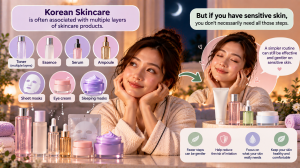
Korean skincare is often associated with multi-step routines, but you don’t need every possible step.
A practical nighttime structure is:
Cleanse → Treat → Moisturize
Optional steps can include:
Toner → Essence → Serum/Ampoule → Moisturizer → Sleeping Mask
But these are additions, not requirements. If your skin only needs cleansing and moisturizing, that’s perfectly reasonable. If you want to add a sleeping mask, treat it as an optional part of the routine, not a mandatory final step.
- For more detailed guidance on product layering, see Korean Night Skincare: What Order Should You Apply Your Products?
- For beginners, see Korean Night Skincare Routine for Beginners: A Simple Step-by-Step Guide.
Frequently Asked Questions
- Is a sleeping mask the same as a night cream?
No, although they can overlap considerably. A night cream is generally a regular nighttime moisturizer, while a sleeping mask is usually positioned as an optional overnight treatment or additional hydration product.
- Can a sleeping mask replace moisturizer?
Sometimes. It depends on the product’s formulation and instructions. Some sleeping masks are designed to replace cream, while others should be applied over moisturizer.
- Should I apply night cream before a sleeping mask?
If the sleeping mask instructions say to use it after moisturizer, yes. If the product is designed to replace moisturizer, you may not need both.
- Can oily skin use a sleeping mask?
Yes. Oily skin can still experience dehydration. Lightweight gel or gel-cream formulations may be more comfortable than very rich products.
- Are sleeping masks good for dry skin?
They can provide additional overnight hydration, but a suitable moisturizer may already be enough.
- Can sensitive skin use a sleeping mask?
Yes, provided the formulation is suitable for the individual’s skin and doesn’t cause irritation. Pay particular attention to potentially irritating ingredients and avoid unnecessary layering.
- Can I use a sleeping mask every night?
It depends on the product. Check the manufacturer’s recommended frequency and consider how your skin responds.
- Do I need a sleeping mask if my night cream works well?
Probably not. If your moisturizer keeps your skin comfortable and hydrated overnight, you may already have everything your routine needs.
Final Thoughts
Sleeping masks and night creams aren’t necessarily competing products.
A night cream is usually your regular nighttime moisturizer, while a sleeping mask is often an optional overnight treatment or additional hydration step.
You don’t need to use both. If your night cream works well, you can keep using it without feeling that your routine is missing something.
If your skin needs additional hydration, a sleeping mask may be a useful addition. And if you’re using one, the most important thing is to understand how that particular product is formulated and how the manufacturer recommends using it.
For beginners, a simple starting point is:
Cleanser → Treatment, if needed → Moisturizer
Add a sleeping mask only when you have a clear reason for doing so.
**The best nighttime routine isn’t the one with the most products. It’s the one that gives your skin what it needs without giving you more skincare than you actually need.