Korean Night Skincare Routine For Dry Skin: A Simple Step-By-Step Guide

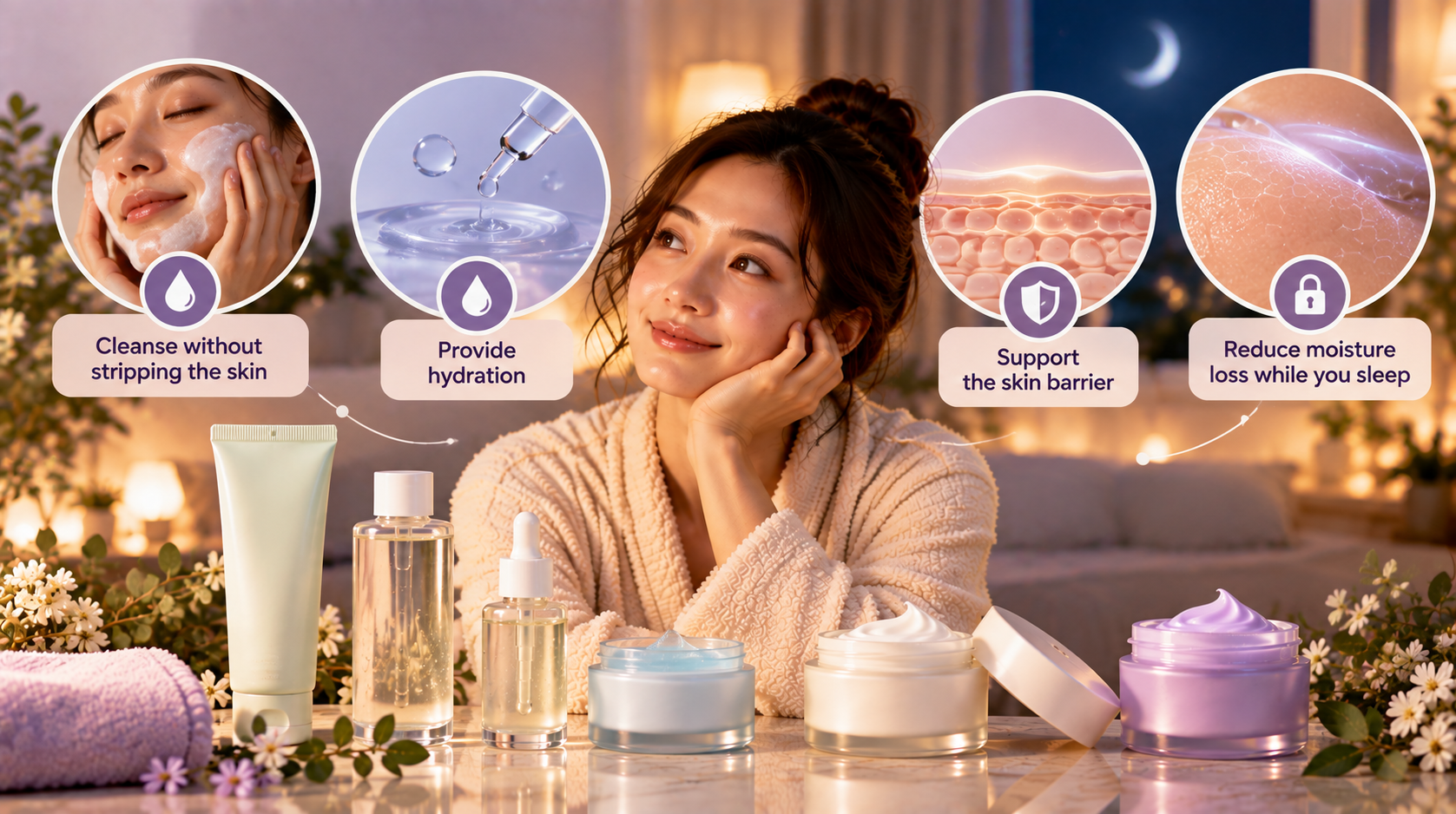
Dry skin often needs more than simply adding a richer cream. A good nighttime skincare routine should help cleanse without stripping the skin, provide hydration, support the skin barrier, and reduce moisture loss while you sleep.
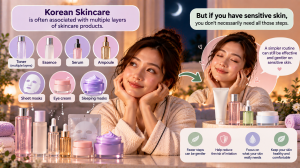
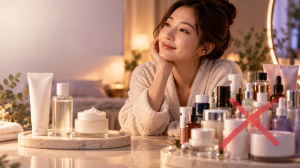
Korean skincare is well known for its layered approach, but that doesn’t mean dry skin needs a complicated 10-step routine. In many cases, a simple combination of gentle cleansing, hydration and moisturization can be more useful than adding product after product.
The goal is to build a routine that gives your skin enough hydration and barrier support without unnecessary layers.
In this guide, we’ll walk through a simple Korean-inspired nighttime routine for dry skin, explain which steps are optional, look at useful ingredients, and cover common mistakes that can make dryness worse.
What Does Dry Skin Need At Night?
A nighttime routine for dry skin should focus on three basic priorities:
- Gentle cleansing
- Hydration
- Moisture retention and barrier support
The skin barrier helps limit water loss and protects the skin from external stressors. When it isn’t functioning well, skin can feel tight, rough, flaky or uncomfortable. That’s why simply applying the thickest cream you can find isn’t necessarily the answer.
A better way to think about a dry-skin routine is:
Cleanse → Hydrate → Treat, if needed → Moisturize
Additional steps are optional.
Korean Night Skincare Routine For Dry Skin
A simple Korean-inspired routine can look like this:
Step 1: Gentle cleanser
Step 2: Toner or essence (optional)
Step 3: Hydrating serum or ampoule
Step 4: Treatment product (optional)
Step 5: Moisturizer
Step 6: Sleeping mask (optional)
You don’t need to use every step.
For many people with dry skin, this simpler routine may be enough:
Cleanser → Hydrating serum → Moisturizer
If your skin is comfortable with that routine, there is no need to add more products simply because they are commonly included in Korean skincare routines.
Step 1: Cleanse Gently
The first step is to remove sunscreen, makeup, excess oil, pollution and other impurities from the skin. For dry skin, however, cleansing should not leave your face feeling tight or uncomfortable. Choose a cleanser that removes buildup without making your skin feel stripped.
What to look for
Depending on your skin and the formulation, you may prefer:
- Gentle cleansing agents
- Cream or mild gel textures
- Hydrating ingredients
- Fragrance-free formulations if fragrance tends to irritate your skin
Your cleanser doesn’t need to contain a long list of treatment ingredients.
Its main job is simple:
Clean the skin without unnecessarily disrupting its comfort or barrier.
**A simple tip
Use lukewarm water rather than very hot water. Very hot water can make dry or sensitive skin feel more uncomfortable.
Step 2: Use A Toner Or Essence (If You Need One)
Toner and essence are common in Korean skincare, but neither is mandatory. For dry skin, a lightweight hydrating toner or essence can provide an additional layer of hydration if you enjoy using one.
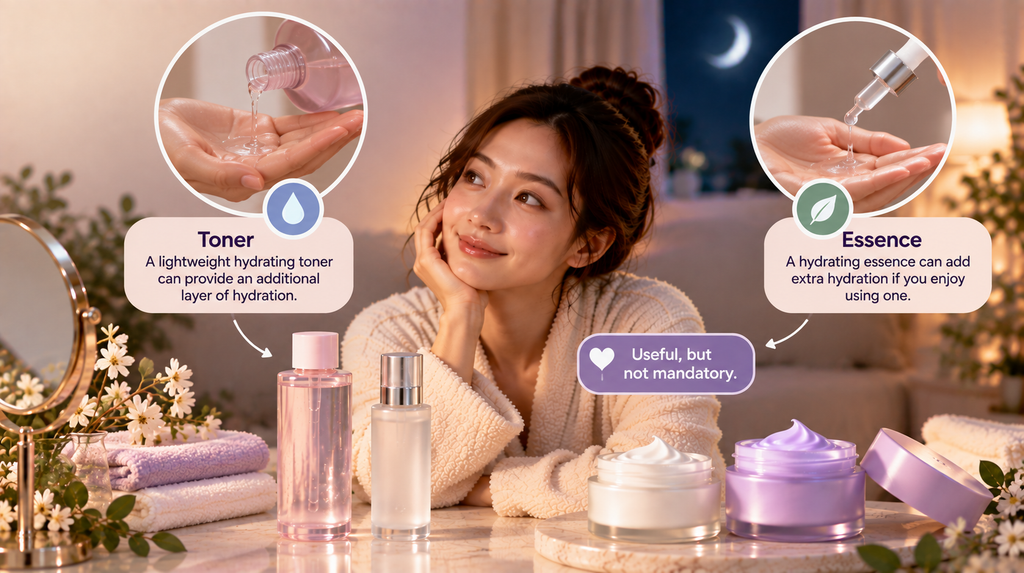
Ingredients commonly found in hydrating products include:
- Glycerin
- Hyaluronic acid
- Panthenol
- Beta-glucan
- Other humectants
However, you don’t necessarily need both a toner and an essence.
If one hydrating product works well, adding another may simply make your routine longer without providing a meaningful benefit.
If your skin feels comfortable without toner or essence. Skip it. A Korean skincare routine doesn’t have to contain every traditional step.
Step 3: Add A Hydrating Serum Or Ampoule
A hydrating serum or ampoule can be useful when your skin feels tight, dry or dehydrated. These products are generally designed to deliver specific ingredients in a lightweight format before moisturizer.
Common ingredients include:
- Hyaluronic Acid
Hyaluronic acid is a humectant that helps attract and retain water.
- Glycerin
Glycerin is another widely used humectant that helps increase hydration.
- Panthenol
Panthenol is commonly included in skincare formulations for its moisturizing and soothing properties.
- Beta-Glucan
Beta-glucan can provide hydration and is also commonly used in products designed to soothe and condition the skin.
You don’t need a serum containing all of these ingredients. Choose a product that addresses your actual needs rather than layering several similar hydrating serums.
Step 4: Add A Treatment Product Only If You Need One
Dry skin doesn’t automatically mean you need multiple treatment products. If you have another specific concern, you may choose an appropriate treatment product.
For example, some formulations contain ingredients such as:
- Niacinamide
- Peptides
- Centella asiatica
- Other targeted skincare ingredients
The important point is to introduce treatments for a specific reason, rather than adding several active products simply because each one sounds beneficial.
For example, you don’t necessarily need to combine:
Hydrating serum + niacinamide serum + peptide serum + exfoliating acid + retinoid
in the same routine.
**For beginners especially, introducing products gradually makes it easier to understand how your skin responds.
Step 5: Moisturize
For dry skin, moisturizer is one of the most important parts of the routine. A moisturizer helps reduce moisture loss and supports the skin barrier. Rather than automatically choosing the thickest cream available, look for a formulation that keeps your skin comfortable throughout the night.
Ingredients commonly used in moisturizers for dry skin include:
- Ceramides
- Glycerin
- Squalane
- Panthenol
- Hyaluronic acid
- Fatty acids
- Emollients
- Occlusive ingredients
Why Ceramides Matter
Ceramides are lipids naturally found in the skin and are commonly included in products designed to support the skin barrier.
What About Squalane?
Squalane is an emollient that helps soften and condition the skin.
What Are Occlusives?
Occlusive ingredients help reduce water loss by forming a protective layer over the skin.
The ideal moisturizer depends on your skin, climate and personal preference. A heavier cream isn’t automatically better if a lighter moisturizer keeps your skin comfortable.
Step 6: Add A Sleeping Mask (Optional)
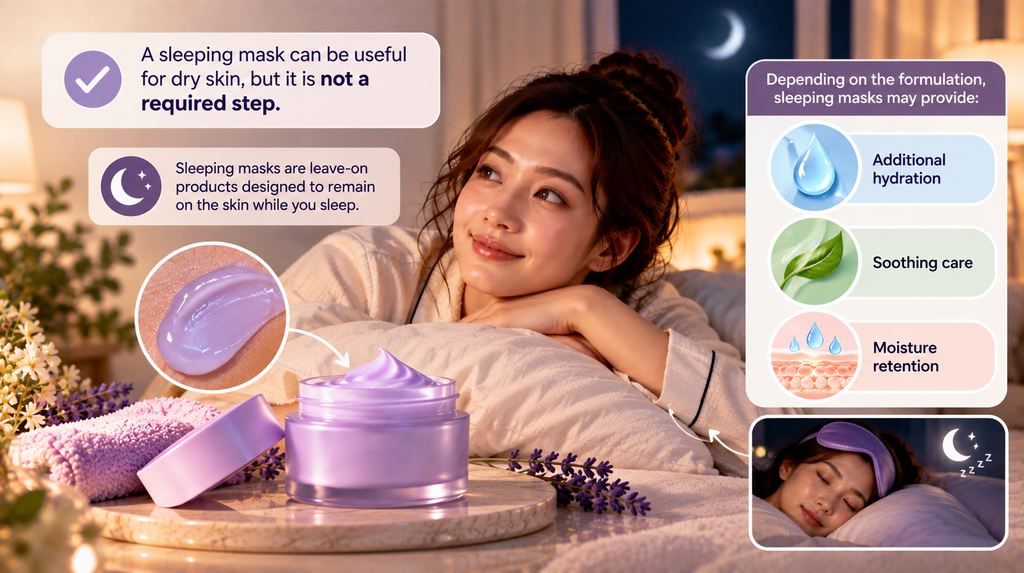
A sleeping mask can be useful for dry skin, but it is not a required step.
Sleeping masks are leave-on products designed to remain on the skin while you sleep. Depending on the formulation, they may provide additional hydration, soothing care or moisture retention.
Some sleeping masks are designed to be applied after moisturizer, while others can function as the moisturizing step themselves.
For example:
- Cleanser → Hydrating serum → Moisturizer → Sleeping mask
may be appropriate when the product is designed to go over moisturizer.
Another sleeping mask may be designed to replace your moisturizer:
Cleanser → Hydrating serum → Sleeping mask
And remember: A sleeping mask isn’t automatically better than a good moisturizer.
If your moisturizer already keeps your skin comfortable overnight, you may not need one. For more information, see: Sleeping Mask vs. Night Cream: What’s the Difference and Which One Do You Need?
Do You Need Toner, Essence, Serum And Sleeping Mask?
This is where Korean skincare can sometimes become confusing. You may see routines containing many different products, but dry skin doesn’t automatically require all of them.
Think about each product according to its function:
| Product | Main purpose | Essential? |
|---|---|---|
| Cleanser | Remove impurities | Yes |
| Toner | Add hydration | Optional |
| Essence | Hydration and conditioning | Optional |
| Hydrating serum | Targeted hydration | Optional |
| Treatment product | Address a specific concern | Optional |
| Moisturizer | Reduce moisture loss and support the barrier | Usually important |
| Sleeping mask | Additional overnight care | Optional |
The goal isn’t to maximize the number of steps. It’s to provide your skin with what it actually needs.
Best Korean Skincare Ingredients For Dry Skin
When choosing Korean skincare for dry skin, look beyond the country of origin and pay attention to the actual formulation.
Some ingredients commonly used in products for dry or dehydrated skin include:
Ceramides
Support the skin barrier and help maintain moisture.
Hyaluronic Acid
A humectant that helps attract and retain water.
Glycerin
A widely used humectant that contributes to skin hydration.
Panthenol
Commonly used for its moisturizing and soothing properties.
Squalane
An emollient that helps soften and condition the skin.
Beta-Glucan
Can provide hydration and soothing benefits.
Centella Asiatica
Commonly used in skincare products designed to soothe and condition the skin.
Snail Mucin
Used in some Korean skincare formulations for hydration and skin conditioning.
However, an ingredient name alone doesn’t tell you how well a product will work.
**The overall formulation, concentration, product quality and your individual skin response all matter.
Dry Skin vs. Dehydrated Skin
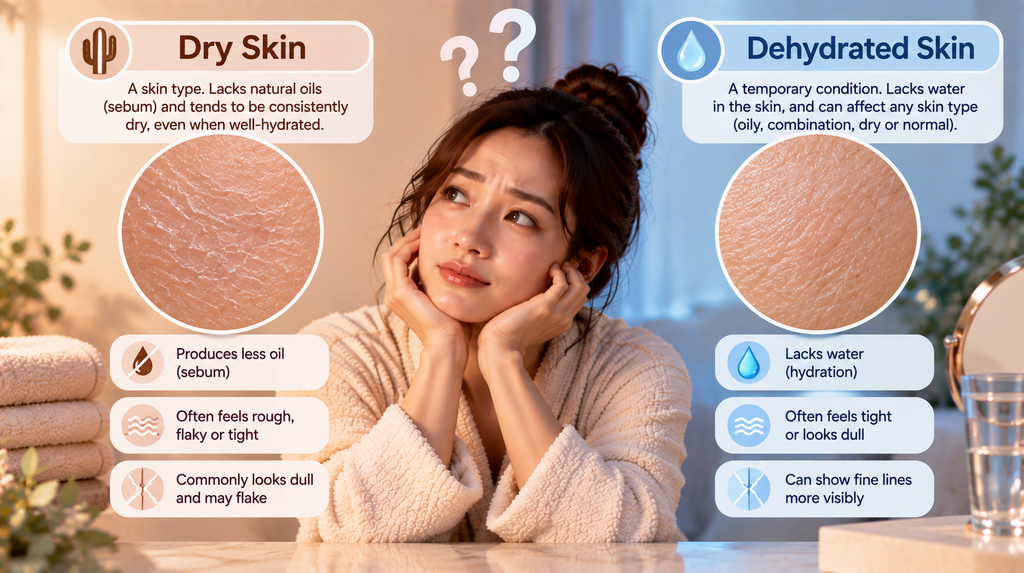
The terms dry and dehydrated are often used interchangeably, but they don’t mean exactly the same thing.
- Dry Skin
Dry skin generally refers to a skin type or tendency toward reduced oil production.
It may feel:
- Rough
- Tight
- Flaky
- Less supple
- Dehydrated Skin
Dehydrated skin refers to a lack of water in the skin. Even oily or combination skin can become dehydrated. This distinction can be useful when building a routine.
- Someone with dry skin may benefit from richer moisturization and barrier-supporting products.
- Someone with dehydrated skin may benefit from increasing appropriate hydration.
- Some people experience both.
What If Your Skin Is Extremely Dry?
If your skin is very dry, don’t automatically respond by adding several more products.
Start by strengthening the basics:
Gentle cleanser → Hydrating product → Moisturizer
If your skin still needs additional overnight moisture, you can consider a suitable sleeping mask or another product designed for that purpose.
Also consider whether something in your routine could be contributing to dryness, such as:
- Over-cleansing
- Very hot water
- Excessive exfoliation
- Too many active ingredients
- Products that irritate your skin
- Frequently changing skincare products
Sometimes the better solution is removing potential sources of irritation rather than adding another product.
Should You Exfoliate Dry Skin?
Dry skin doesn’t mean you can never exfoliate. However, excessive exfoliation can leave already-dry or irritated skin feeling worse. If you use AHAs, BHAs, PHAs or other exfoliating products, introduce them carefully and follow the product instructions.
You don’t need to exfoliate every night. A simple approach is to avoid combining too many potentially irritating products in the same routine.
For example:
Exfoliation night:
Cleanser → Exfoliant → Moisturizer
Hydration-focused night:
Cleanser → Hydrating serum → Moisturizer
The appropriate frequency depends on the product and your skin’s tolerance.
What About Retinoids?
Retinoids can be useful for certain skincare concerns, but they aren’t an essential part of a basic dry-skin routine. If you use a retinoid, introduce it carefully and monitor your skin for dryness or irritation.
A simple retinoid night might look like:
Cleanser → Retinoid → Moisturizer
Depending on the product and your skin’s tolerance, you may choose additional moisturizing support. The important point is that not every night needs to be an active-treatment night.
Common Mistakes When Caring For Dry Skin
- Using Too Many Products
More products don’t necessarily mean more hydration. If several products perform similar functions, your routine can become unnecessarily complicated. - Choosing the Richest Product Available
A very thick cream isn’t automatically the best choice for dry skin. Formulation, comfort and your skin’s response matter more than texture alone. - Over-Cleansing
Cleansing too aggressively or too frequently can leave dry skin feeling tight and uncomfortable. - Over-Exfoliating
Exfoliation can have a place in a skincare routine, but excessive exfoliation may contribute to dryness and irritation. - Introducing Several Actives at Once
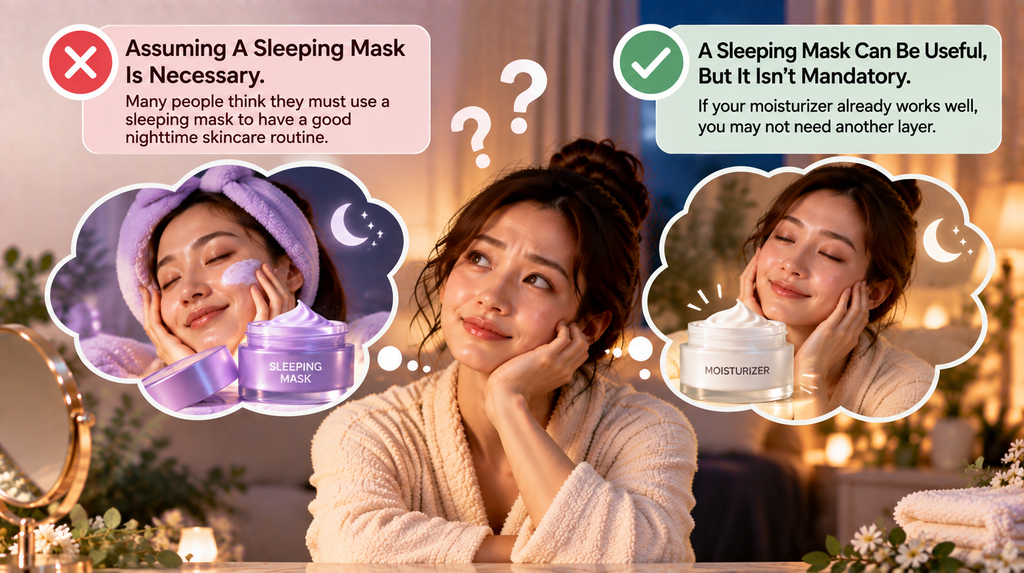
If you introduce multiple new products simultaneously, it becomes difficult to know which one is helping or causing irritation. Introduce changes gradually whenever possible. - Assuming A Sleeping Mask Is Necessary
A sleeping mask can be useful, but it isn’t a mandatory step. If your moisturizer already works well, you may not need another layer.
A Simple 3-Step Korean Night Routine For Dry Skin
If you’re overwhelmed by the number of Korean skincare products available, start with the basics.
Step 1: Cleanse
Use a gentle cleanser to remove the day’s buildup.
Step 2: Hydrate
Use a hydrating serum or essence if your skin benefits from one.
Step 3: Moisturize
Apply a moisturizer that keeps your skin comfortable overnight.
Cleanser → Hydrate → Moisturize
That’s enough to build a functional nighttime routine. You can add other products later when you have a specific reason to do so.
How To Know If Your Routine Is Working
Don’t judge your routine by the number of products sitting on your bathroom shelf. Pay attention to how your skin feels.
A suitable routine should generally leave your skin feeling:
- Comfortable
- Soft
- Less tight
- Adequately moisturized
- Not excessively greasy
- Not persistently irritated
If your skin becomes increasingly dry, itchy, irritated or uncomfortable after introducing a new product, reconsider the routine rather than automatically adding another product.
Consistency also matters. Changing your skincare routine every few days makes it difficult to understand whether a product is actually helping.
Frequently Asked Questions
What is the best Korean skincare routine for dry skin at night?
A simple routine can be:Cleanser → Hydrating serum or essence → Moisturizer. A sleeping mask can be added when additional overnight hydration is needed and the product is suitable for your skin.
Do I need a toner if I have dry skin?
No. A hydrating toner can be useful, but it isn’t essential if your other products provide enough hydration.
Is a sleeping mask necessary for dry skin?
No. It can provide additional overnight hydration, but a suitable moisturizer may already provide everything your skin needs.
Can I use a sleeping mask every night?
It depends on the specific product. Check the manufacturer’s instructions and consider the ingredients and how your skin responds.
Should dry skin use hyaluronic acid?
Hyaluronic acid can be useful for hydration, but it isn’t the only option. Glycerin, panthenol and beta-glucan can also contribute to a hydrating routine.
Should I exfoliate dry skin?
You can, but more exfoliation isn’t necessarily better. Use exfoliating products according to their instructions and your skin’s tolerance.
Can oily skin use this type of routine?
Yes, although oily skin may require lighter textures and less occlusive products. Dryness and dehydration aren’t exactly the same thing.
Final Thoughts
A Korean night skincare routine for dry skin doesn’t need to involve a long list of products.
The foundation is simple:
Cleanse → Hydrate → Moisturize
From there, you can add a toner, essence, treatment serum or sleeping mask when there is a specific reason to do so.
The most important priorities are hydration, moisture retention, barrier support and consistency, not trying to recreate the longest Korean skincare routine you can find.
Dry skin doesn’t necessarily need more products. Sometimes it needs fewer, better-chosen products used consistently.
The goal isn’t to build the longest nighttime routine. It’s to build a routine that keeps your skin comfortable, hydrated and supported throughout the night.