Korean Night Skincare Routine For Beginners: A Simple Step-by-Step Guide

Starting a Korean skincare routine can feel overwhelming. You may see routines with seven, eight, or even more steps, along with unfamiliar products such as essences, ampoules, emulsions, exfoliators, sheet masks, and sleeping masks.
But you don’t need a shelf full of products to get started. A good Korean night skincare routine is less about following a long checklist and more about understanding what each step does, which products you actually need, and how to build a routine your skin can tolerate.
For beginners, a simple routine built around cleansing, hydration, treatment when needed, and moisturizing can be enough. Once your skin is comfortable with the basics, you can gradually introduce additional products based on your skin’s needs.
This guide explains how to build a simple Korean-inspired nighttime skincare routine, what order to apply products, how to adapt your routine to different skin types, and the common mistakes beginners should avoid.
What Makes A Korean Skincare Routine Different?
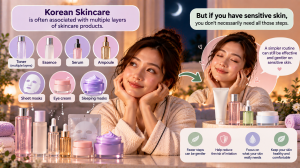
Korean skincare is often associated with elaborate multi-step routines, but the underlying approach doesn’t require using a large number of products.
A useful way to think about Korean skincare is to focus on hydration, skin-barrier support, gentle care, and targeted treatment rather than simply counting the number of steps.
Different products can serve different purposes:
- Cleansers remove makeup, sunscreen, oil, sweat, and other residue.
- Toners can provide lightweight hydration after cleansing.
- Essences are generally used to add hydration and conditioning.
- Serums and ampoules are usually more targeted toward particular skin concerns.
- Moisturizers help maintain hydration and reduce moisture loss.
- Sleeping masks can provide an additional overnight layer of hydration or conditioning.
However, you don’t necessarily need every category.
The important principle for a beginner is simple:
More skincare steps do not automatically mean better skincare.
A short routine that your skin tolerates and that you can maintain consistently is often more practical than a complicated routine that leaves your skin irritated or becomes difficult to follow.
How Many Steps Does A Beginner Korean Night Routine Need?
There is no official number of steps that a Korean skincare routine must contain.
You can start with just two basic steps:
- Cleanse
- Moisturize
If you have a particular skin concern you want to address, you can then introduce a treatment product.
A more complete beginner routine might look like:
Cleanser → Toner or Essence → Serum or Ampoule → Moisturizer
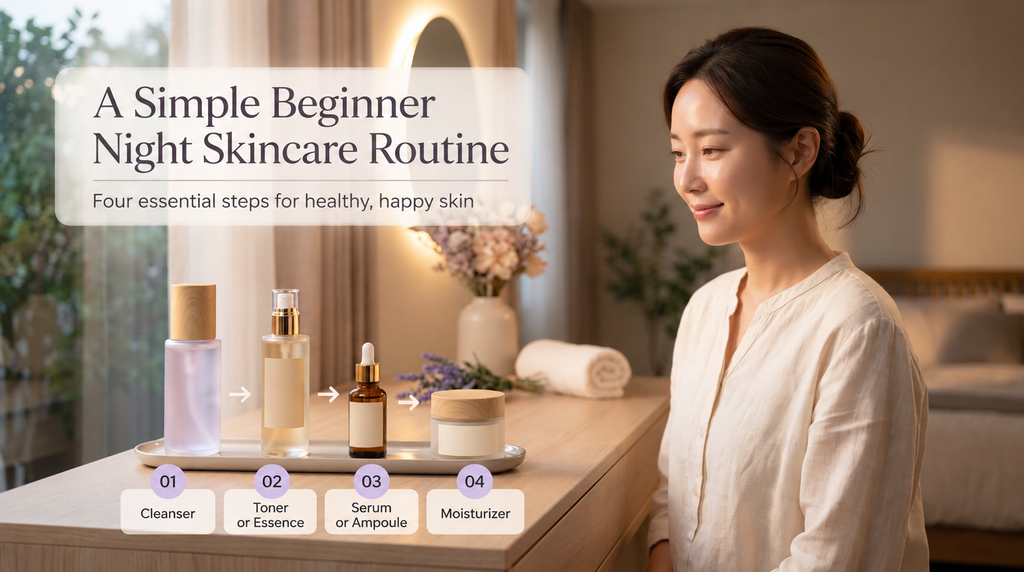
A sleeping mask can be added as an optional final step. This is important because you don’t need to use every product category every night. Your routine should be built around what your skin actually needs rather than around how many products you can fit onto your bathroom shelf.
Korean Night Skincare Routine For Beginners: Step by Step
Step 1: Remove Makeup And Sunscreen
If you wear makeup or sunscreen during the day, start by removing them before cleansing. Makeup and sunscreen are designed to stay on your skin, so a normal water rinse isn’t enough to reliably remove everything.
Depending on your preferences and the products you use, you might use:
- Cleansing oil
- Cleansing balm
- Micellar water
- Another suitable makeup remover
This first step is sometimes called the first cleanse.
Do You Always Need to Double Cleanse?
Not necessarily. Double cleansing can be useful when you need to remove makeup, sunscreen, or other products that are difficult to remove with a single cleanse. But it shouldn’t automatically become a rule that everyone must follow every night.
If your skin becomes dry, tight, or uncomfortable after cleansing, consider whether you are cleansing too aggressively or using products that aren’t suitable for your skin. The goal is to remove what needs to be removed without unnecessarily disrupting your skin’s comfort and barrier.
Step 2: Cleanse Your Skin
After removing makeup and sunscreen, use a facial cleanser that suits your skin. The purpose of cleansing is straightforward: remove remaining residue, excess oil, sweat, and impurities while avoiding unnecessary irritation.
Apply the cleanser gently rather than scrubbing aggressively. Rinse thoroughly and pat your face dry with a clean towel. Your skin should feel clean and comfortable, not tight, squeaky, burning, or excessively dry.
What Should Beginners Look For In A Cleanser?
The best cleanser isn’t necessarily the one that produces the most foam or leaves your face feeling extremely “squeaky clean.” Instead, consider how your skin feels after washing.
If your face consistently feels tight or uncomfortable immediately after cleansing, your cleanser may be too harsh for your skin, or you may be cleansing too aggressively.
Step 3: Apply Toner Or Essence
This is where Korean skincare often introduces an additional hydration step. A toner or essence can provide lightweight hydration and prepare the skin for the products that follow.
However, you don’t necessarily need both. For beginners, choosing one is perfectly reasonable. Apply a small amount to clean skin and gently pat or spread it across your face according to the product’s instructions.
Toner vs. Essence: What’s The Difference?
The terminology can be confusing because skincare categories don’t always have perfectly consistent definitions.
Generally speaking:
Toner is usually a lightweight product applied after cleansing. Modern hydrating toners can provide moisture and conditioning rather than simply being used to remove leftover residue.
Essence is often positioned as a lightweight hydrating or conditioning step between cleansing and treatment products.
There can be considerable overlap between the two.
So instead of becoming overly concerned about the label, ask: Does this product provide something my skin actually needs?
If your cleanser followed by moisturizer already leaves your skin comfortable, adding a toner or essence isn’t automatically necessary.
Step 4: Apply Serum Or Ampoule
Serums and ampoules are generally the more targeted part of a skincare routine. Instead of simply providing basic hydration, they may be formulated around particular skin concerns or ingredients.
Depending on the formulation, you may encounter ingredients associated with:
- Hydration
- Niacinamide
- Antioxidants
- Soothing
- Skin-barrier support
- Uneven-looking skin tone
- Visible signs of aging
The important thing for beginners is not to collect several treatment products simply because each one sounds beneficial. One well-chosen treatment product is usually easier to understand and manage than several products layered together.
Apply the product according to its instructions. If you’re introducing a product containing a stronger active ingredient, start gradually rather than assuming that more frequent application will produce faster results.
And remember that a serum or ampoule is optional. If you don’t have a particular concern you want to address, you can simply move from your hydrating step to moisturizer.
Step 5: Apply Moisturizer
Moisturizer is one of the most useful foundation steps in a beginner skincare routine. Its role is to help maintain hydration and reduce moisture loss while supporting the skin’s barrier. The ideal texture depends on your skin and personal preference.
For example:
- Oily skin: A lightweight lotion or gel-cream may feel more comfortable.
- Combination skin: A balanced moisturizer may work well, with additional product applied to areas that become dry.
- Dry skin: A richer cream may provide greater comfort.
- Sensitive skin: A simple, fragrance-free formula may be preferable if your skin is easily irritated.
You don’t need to use a heavy moisturizer simply because it is nighttime. A moisturizer should leave your skin feeling comfortable rather than excessively greasy, tight, or irritated.
Step 6: Add A Sleeping Mask (Optional)
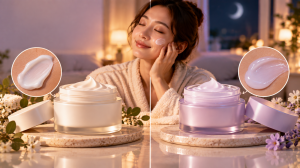
A sleeping mask, sometimes called a sleeping pack, is an optional addition to a nighttime routine. Unlike a traditional wash-off face mask, a sleeping mask is designed to remain on the skin while you sleep.
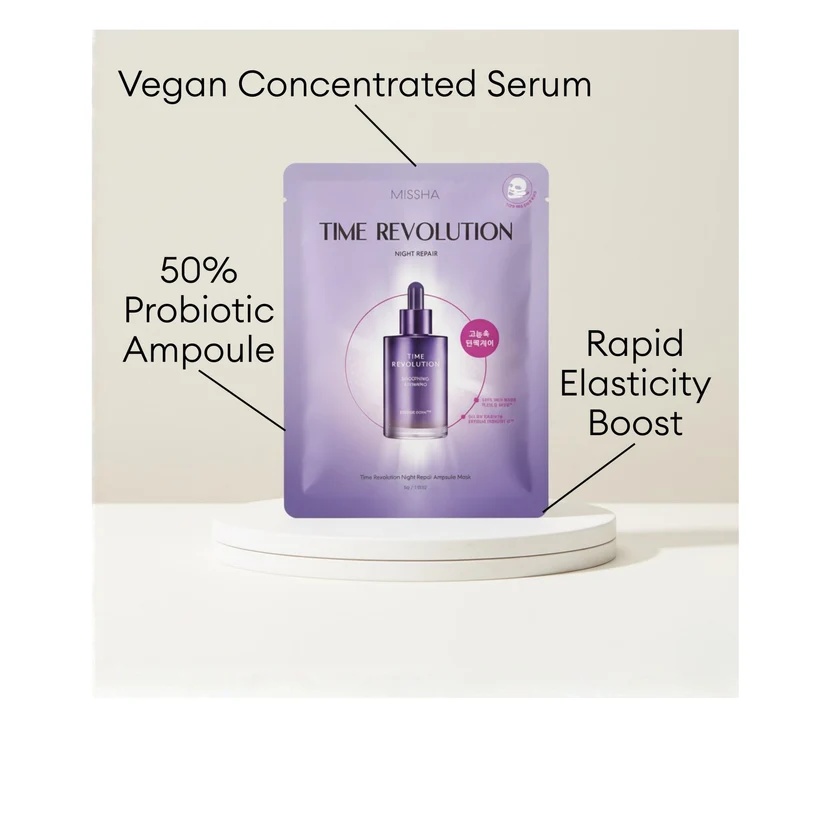
Depending on the formulation, it may provide additional hydration, conditioning, or other skincare benefits. Sleeping masks are generally used toward the end of the nighttime routine, but the exact placement depends on the product. Some are designed to function as the final moisturizing step, while others are intended to be applied over your normal moisturizer.
Always follow the instructions for the specific product you’re using.
If you’re new to sleeping masks, start with a small amount and see how your skin responds. For a more detailed explanation of application and routine placement, see our guide: [How to Use a Korean Sleeping Mask: A Step-by-Step Night Routine]
Do You Need Both Moisturizer And A Sleeping Mask?
Not necessarily. This is one of the areas where beginners can easily end up using more products than they actually need. Some sleeping masks are designed to act as an additional moisturizing layer, while others are intended to be used over your existing skincare routine.
Therefore, don’t assume that adding a sleeping mask automatically means you must also apply a thick layer of moisturizer underneath it. Check the product instructions.
More importantly, pay attention to how your skin feels. If your skin is already adequately moisturized and comfortable, adding another heavy layer may not provide a meaningful advantage.
The Simplest Korean Night Routine For Beginners
If everything above still sounds like too much, start here.
Basic routine
Cleanser → Moisturizer
That’s enough to establish a simple nighttime foundation.
Once your skin is comfortable with those two steps, you can add:
Hydrating routine
Cleanser → Toner or Essence → Moisturizer
If you have a particular skin concern you want to address, you could then introduce:
Treatment routine
Cleanser → Toner or Essence → Serum or Ampoule → Moisturizer
And if you want additional overnight hydration:
Overnight routine
Cleanser → Toner or Essence → Serum or Ampoule → Moisturizer → Sleeping Mask
You don’t have to work your way through all four versions. Think of them as different levels that you can choose from depending on your skin and lifestyle.
What Order Should Korean Skincare Products Go In?
A useful general principle is:
Cleanse → Lightweight products → Treatment products → Moisturizer → Optional final layer
| Step | Product | Main purpose |
|---|---|---|
| 1 | Makeup/Sunscreen Remover | Removes makeup and sunscreen |
| 2 | Cleanser | Cleanses the skin |
| 3 | Toner or Essence | Adds lightweight hydration |
| 4 | Serum or Ampoule | Targets specific concerns |
| 5 | Moisturizer | Maintains hydration and supports the skin barrier |
| 6 | Sleeping Mask | Optional overnight layer |
This is a framework rather than an unbreakable rule. Some products have specific instructions that change where or how they should be used. When that happens, follow the manufacturer’s directions.
Do You Need To Follow The Full Korean 10-Step Routine?
The answer is “No”.
The famous “10-step Korean skincare routine” is better understood as a collection of product categories that can be incorporated into a routine rather than a requirement that everyone must follow every night.
A traditional example might include:
- Oil cleanser
- Water-based cleanser
- Exfoliator
- Toner
- Essence
- Serum
- Sheet mask
- Eye cream
- Moisturizer
- Sunscreen
But even this list shouldn’t be interpreted as a mandatory nightly checklist. Some steps are used only occasionally. And sunscreen belongs primarily in your morning/daytime routine, because its purpose is to protect your skin from UV exposure.
Instead of asking:
“How many steps should I use?”
Ask:
“What does my skin actually need?”
That question will lead to a much more manageable routine.
How To Build Your Routine Around Your Skin Type
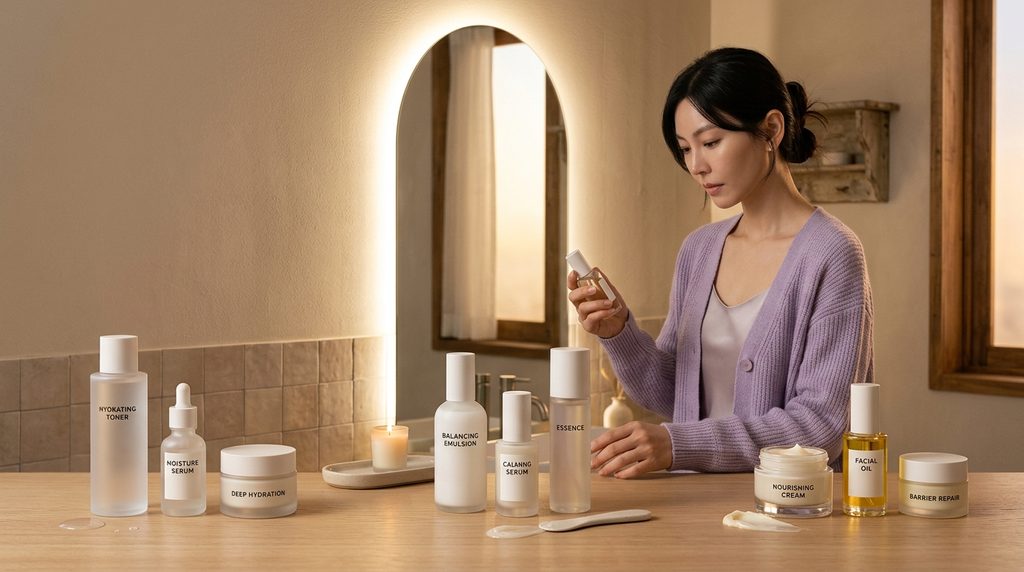
- For Oily Skin
Consider focusing on:
- Gentle cleansing
- Lightweight hydration
- A suitable treatment product if needed
- Lightweight moisturizer
One common misconception is that oily skin doesn’t need moisturizer. It does. The goal is simply to find a moisturizer with a texture that feels comfortable for your skin. Avoid assuming that aggressively drying the skin will solve oiliness.
- For Dry Skin
A dry-skin routine may benefit from greater emphasis on hydration and moisture.
Consider:
- Gentle cleansing
- Hydrating toner or essence
- Serum or ampoule if needed
- Nourishing moisturizer
- Optional sleeping mask
The most useful indicator is often how your skin feels. If your skin feels persistently tight or uncomfortable after your routine, consider whether your cleansing or moisturizing approach needs adjustment.
- For Combination Skin
Combination skin can be more complicated because different areas of the face may behave differently. You may find that a lightweight moisturizer works comfortably across most of the face, while drier areas need a little more product.
You don’t necessarily need completely different products for every part of your face. Start with a simple routine and adjust individual areas only when necessary.
- For Sensitive Skin
Keep things simple.
A beginner routine can be as straightforward as:
Gentle cleanser → Simple moisturizer
Once your skin is comfortable with the basics, introduce new products one at a time. This is useful because if irritation occurs, it becomes easier to identify which newly introduced product may have caused the problem.
Also remember that “Korean skincare” describes a very broad range of products. A product being Korean does not automatically mean it will be suitable for sensitive skin.
How Often Should Beginners Use Korean Skincare?
The answer depends on the individual product. Basic products such as cleansers and moisturizers can form the foundation of a regular routine. Other products may need to be used less frequently.
- Exfoliants
Don’t assume that exfoliating more often will produce better results. Overuse can make a routine unnecessarily irritating. Start conservatively and follow the instructions for the product you’re using.
- Serums and Ampoules
Usage depends on the ingredients and formulation. Some are designed for regular use, while products containing stronger active ingredients may need to be introduced gradually. Read the product instructions rather than assuming that every serum should be used twice a day.
- Sleeping Masks
Some sleeping masks are designed for frequent use, while others may be better suited to occasional use. Again, follow the instructions for the particular formula.
- The One-Product-at-a-Time Rule
If you’re new to skincare, this is one of the simplest habits you can adopt.
Introduce new products gradually.
Adding five new products to your routine at the same time may sound exciting, but it creates a problem: if your skin improves or becomes irritated, you won’t know which product was responsible. A slower approach gives you much more useful information about how your skin responds.
Common Beginner Mistakes To Avoid
- Starting With Too Many Products
This is probably the most common beginner mistake. Seeing a beautiful Korean skincare routine online can make it tempting to purchase every product category immediately. But a complicated routine isn’t automatically a better routine. Start with the basics and add products only when you have a reason to do so.
- Using Too Many Active Ingredients
Retinoids, exfoliating acids, vitamin C, acne treatments, and other active ingredients can all have a place in skincare. The problem is assuming that combining more active ingredients will automatically produce better results.
Using several potentially irritating products without understanding their compatibility can make your routine difficult for your skin to tolerate. Introduce active products gradually and follow their instructions.
- Applying Too Much Product
More product doesn’t necessarily mean better results. Skincare isn’t about covering your face with the thickest possible layer. Follow the recommended amount and allow each product to be used as intended.
- Changing Products Too Frequently
Give your routine time. Constantly replacing products makes it difficult to understand what is actually working for your skin. If something is comfortable and serving its purpose, there isn’t always a reason to replace it simply because a newer product has appeared.
- Assuming Every Korean Skincare Product Is Gentle
“Korean skincare” is an extremely broad category. Products can contain exfoliating acids, retinoids, fragrance, essential oils, or other ingredients that may not suit everyone.
Don’t evaluate a product solely by its country of origin. Evaluate the individual formulation and your own skin’s response.
- Ignoring Your Skin’s Response
If your skin becomes persistently irritated, painful, excessively dry, or uncomfortable, don’t simply add another product to try to fix the problem. Sometimes the better approach is to simplify the routine.
If you experience significant or persistent skin problems, professional medical advice may be more appropriate than continuing to experiment with skincare products.
How Long Does A Korean Night Skincare Routine Take?
It doesn’t have to take 30 minutes.
A basic routine can take only a few minutes: Cleanse → Moisturize
A slightly more complete routine might be: Cleanse → Serum → Moisturize
Adding toner, essence, or a sleeping mask may add a little more time, but there is no requirement to turn your nighttime skincare routine into a lengthy ritual. The most important factor is whether the routine is practical enough for you to maintain.
A three-minute routine that you consistently follow can be more useful than a 30-minute routine that you abandon after two weeks.
What About Skincare And Sleep?
Nighttime skincare and sleep are related, but they aren’t the same thing. Applying an expensive skincare product before bed cannot compensate for consistently poor sleep.
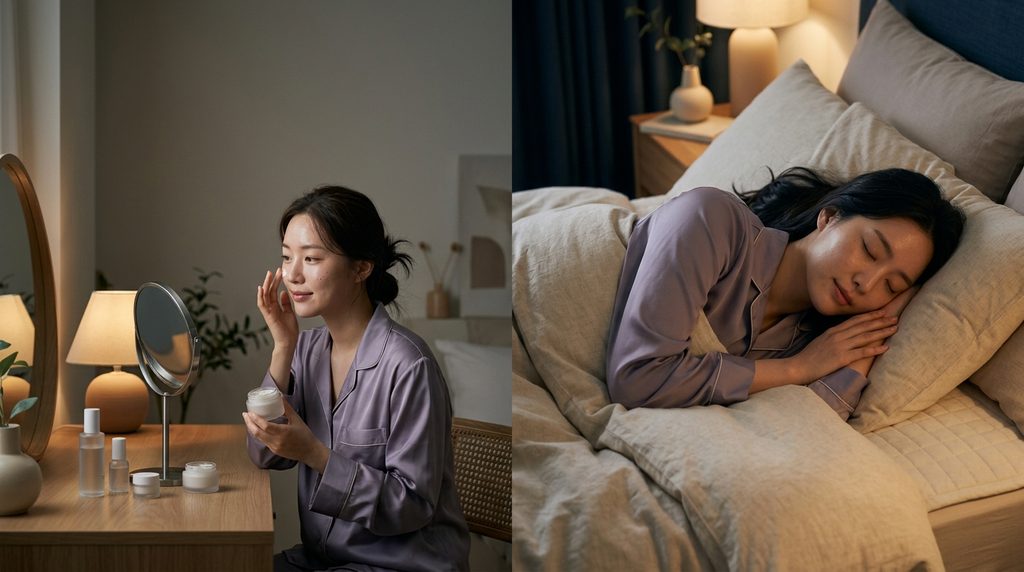
Sleep is an important part of overall health, while skincare products are designed to support the condition and appearance of your skin. Your nighttime routine should therefore be viewed as one part of a broader approach to skin health, rather than a replacement for healthy sleep habits.
If you want to understand more about what happens to your skin overnight, read: [Why Your Skin Repairs Itself While You Sleep (And How to Support It)]
This also highlights an important point about the concept of “beauty sleep”: skincare is only one piece of the picture.
A Beginner’s Korean Night Routine You Can Actually Maintain
If you’re completely new to Korean skincare, don’t start by buying ten products.
Start with the fundamentals.
Basic Routine
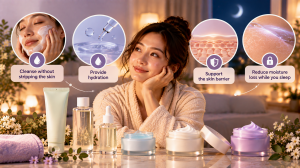
- Cleanser
Remove the day’s buildup without aggressively stripping your skin. - Moisturizer
Help maintain hydration and support the skin barrier.
Expanded Routine
- Cleanser
↓ - Toner or Essence
↓ - Serum or Ampoule
↓ - Moisturizer
Optional Overnight Routine
- Cleanser
↓ - Toner or Essence
↓ - Serum or Ampoule
↓ - Moisturizer
↓ - Sleeping Mask
The important thing is that you don’t have to reach the final version. You can stop at the point where your skin feels adequately cared for and your routine remains easy to maintain.
Frequently Asked Questions
- Is Korean skincare suitable for beginners?
Yes. Korean skincare includes everything from simple cleansers and moisturizers to highly active treatment products. The key isn’t whether a product comes from Korea. It’s choosing products appropriate for your skin and introducing them gradually. - How many Korean skincare products should I use at night?
There is no required number. A cleanser and moisturizer can establish a basic nighttime routine. You can then add a toner, essence, serum, ampoule, or sleeping mask if there is a specific reason to do so. - Should I use toner or essence first?
Both are generally used after cleansing. If you’re using both, the lighter, more watery product is commonly applied first, but product instructions should take priority. And remember: beginners don’t necessarily need both. - Can I use a sleeping mask every night?
It depends on the product and your skin. Some sleeping masks are designed for frequent use, while others may be better used occasionally. Follow the manufacturer’s instructions and pay attention to how your skin responds.
For a more detailed guide, see: [How to Use a Korean Sleeping Mask: A Step-by-Step Night Routine]
- Do I need a serum if I already use moisturizer?
Not necessarily. A moisturizer can provide the foundation of your routine. A serum or ampoule becomes more useful when you want to address a particular concern or introduce a specific type of treatment. - Do I need sunscreen at night?
No. Sunscreen is primarily a daytime skincare step because its purpose is to protect the skin from UV radiation. Apply sunscreen during the day according to the product’s instructions. - Is a 10-step Korean skincare routine necessary?
No. The number of steps matters far less than choosing appropriate products, using them correctly, and maintaining a routine that your skin tolerates.
Final Thoughts
A Korean night skincare routine doesn’t have to be complicated.
For beginners, the best place to start is with the fundamentals:
Cleanse → Hydrate → Treat if needed → Moisturize
From there, you can gradually introduce additional products such as essences, ampoules, exfoliants, or sleeping masks when they serve a clear purpose.
The goal isn’t to copy someone else’s 10-step routine. It’s to build a nighttime routine that fits your skin, your lifestyle, and your ability to maintain it consistently.
And remember that skincare is only one part of nighttime skin health. Good sleep, consistent daytime sun protection, and sensible skincare habits all contribute to taking care of your skin.
Start simple. Pay attention to how your skin responds. Add products only when they have a clear purpose.
That is a much better starting point than trying to build the most complicated routine possible.