Korean Skincare For Sensitive Skin At Night: A Simple Routine That Won’t Overwhelm Your Skin

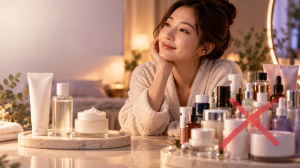
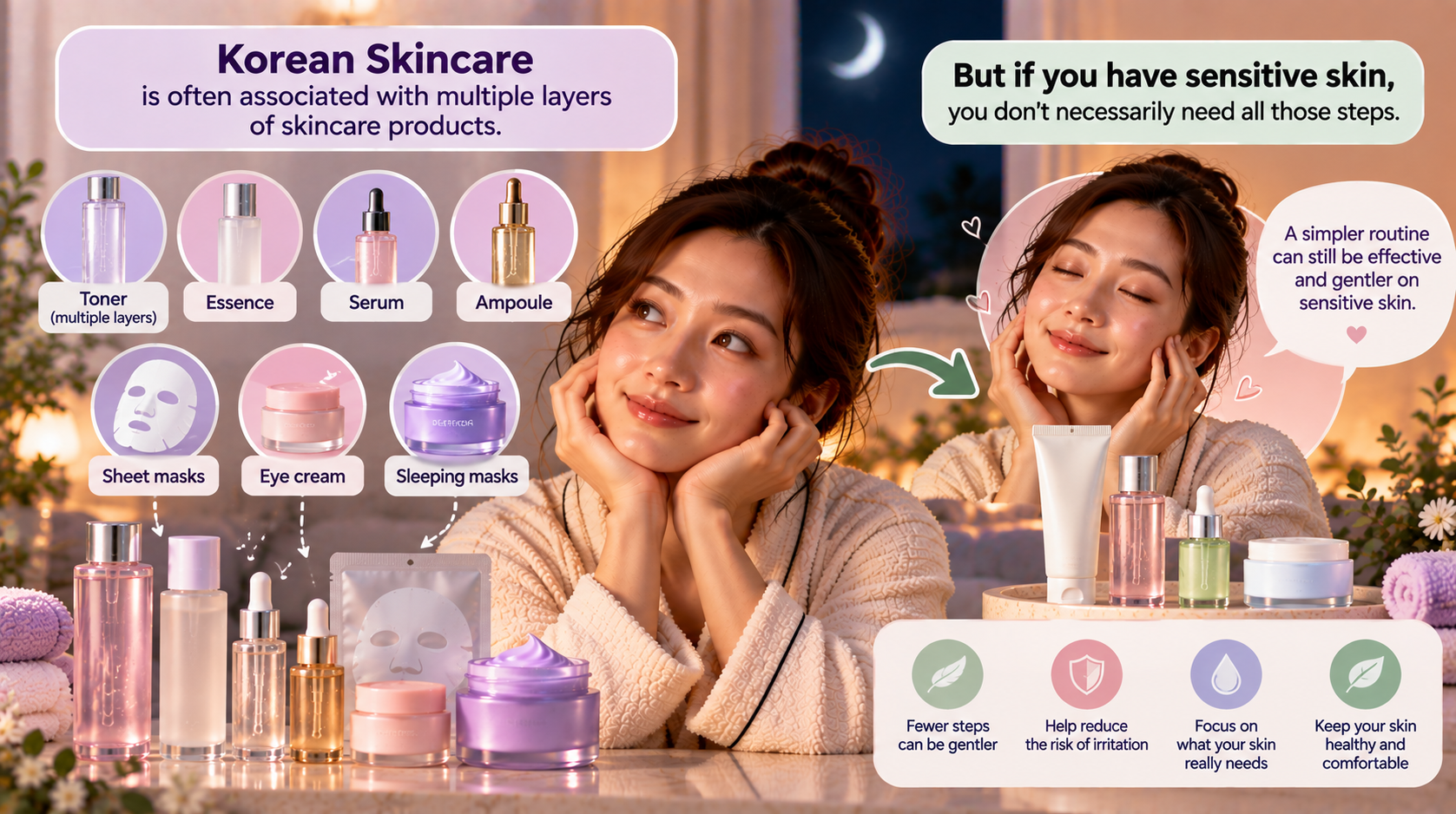
Korean skincare is often associated with multiple layers of toner, essence, serum, ampoule, sheet masks, eye cream and sleeping masks. But if you have sensitive skin, you don’t necessarily need all those steps.
In fact, adding too many products can make a sensitive-skin routine harder to manage. If your skin becomes irritated, it can also become difficult to identify which product caused the problem.
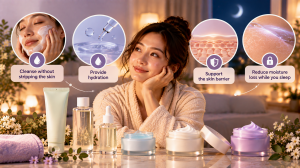
A better approach is to focus on gentle cleansing, hydration, barrier support and gradual product introduction.
A simple Korean-inspired nighttime routine can be as straightforward as:
Gentle cleanser → One hydrating or soothing treatment → Moisturizer
And sometimes, even:
Cleanser → Moisturizer
is enough.
The goal isn’t to recreate the longest Korean skincare routine you can find. It’s to build a routine that your skin can comfortably tolerate and that you can use consistently.
What Does “Sensitive Skin” Actually Mean?
Sensitive skin is commonly used to describe skin that reacts easily to skincare products or environmental factors.
Possible signs include:
- Stinging
- Burning
- Redness
- Tightness
- Itching
- Dryness
- Flaking
- Increased reactivity
However, experiencing irritation from one product doesn’t necessarily mean you have permanently sensitive skin.
Your skin may become temporarily reactive because of:
- Over-cleansing
- Excessive exfoliation
- Too many active ingredients
- A product that doesn’t agree with your skin
- A damaged or stressed skin barrier
That’s why a predictable, uncomplicated routine can be useful when your skin is reactive.
Why Sensitive Skin May Benefit From A Simpler Korean Routine
There is nothing wrong with a multi-step Korean skincare routine if your skin tolerates it. But layering is optional, not mandatory.
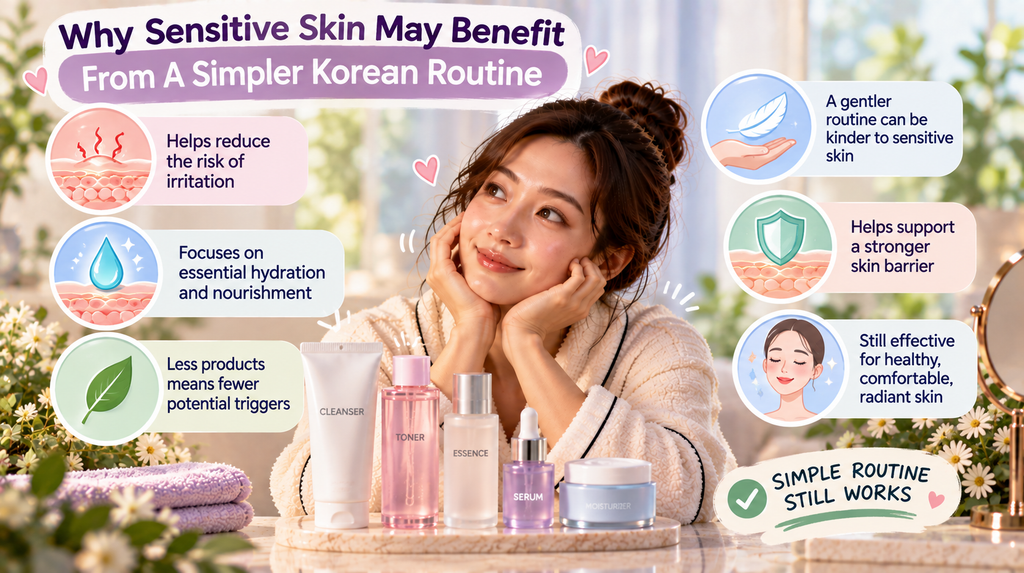
A routine might traditionally look like:
Cleanser → Toner → Essence → Serum → Ampoule → Eye Cream → Moisturizer → Sleeping Mask
Sensitive skin doesn’t automatically benefit from every one of those steps. Instead, consider each product according to its purpose.
Fewer products, clearer purposes.
If you know why you’re using each product, it’s easier to decide whether you actually need it. It also makes it easier to identify potential sources of irritation.
The Simple Korean Night Routine For Sensitive Skin
A practical starting routine is:
Step 1: Gentle cleanser
Remove sunscreen, makeup, sweat and buildup without leaving the skin feeling excessively stripped.
Step 2: One hydrating or soothing treatment
Choose one toner, essence, serum or ampoule if your skin benefits from it. You don’t automatically need all four.
Step 3: Moisturizer
Finish with a moisturizer that keeps your skin comfortable and supports moisture retention.
So your basic routine becomes:
Cleanser → Hydrating/Soothing Treatment → Moisturizer
Everything else is optional.
Step 1: Choose a Gentle Cleanser
The primary purpose of a cleanser is to remove buildup from the skin.
For sensitive skin, you generally want a cleanser that cleans effectively without leaving your face feeling excessively tight, dry or uncomfortable.
Depending on your skin, you may prefer:
- A gentle gel or cream texture
- A mild cleansing formula
- Hydrating ingredients such as glycerin
- A fragrance-free option if fragrance tends to bother your skin
- A comfortable after-feel rather than a “squeaky clean” sensation
One example of a Korean cleanser you could consider is Beauty of Joseon Green Plum Refreshing Cleanser.
However, don’t assume a product is suitable simply because it is Korean.
** Korean skincare includes both gentle and highly active formulations. The complete formula and your individual response matter more than the country of origin.
Do You Need An Oil Cleanser?
Not necessarily.
An oil cleanser or cleansing balm can be useful for removing:
- Waterproof makeup
- Heavy sunscreen
- Long-wearing makeup
- Water-resistant products
You can then follow with a gentle water-based cleanser if appropriate.
However, if one cleanser is already sufficient for what you wear, you don’t necessarily need to double cleanse every night. For sensitive skin, unnecessary cleansing can sometimes be counterproductive.
Step 2: Do You Need Toner Or Essence?
No. Toner and essence can be useful, but neither is mandatory. A gentle hydrating toner may provide an additional layer of hydration if your skin tolerates it.
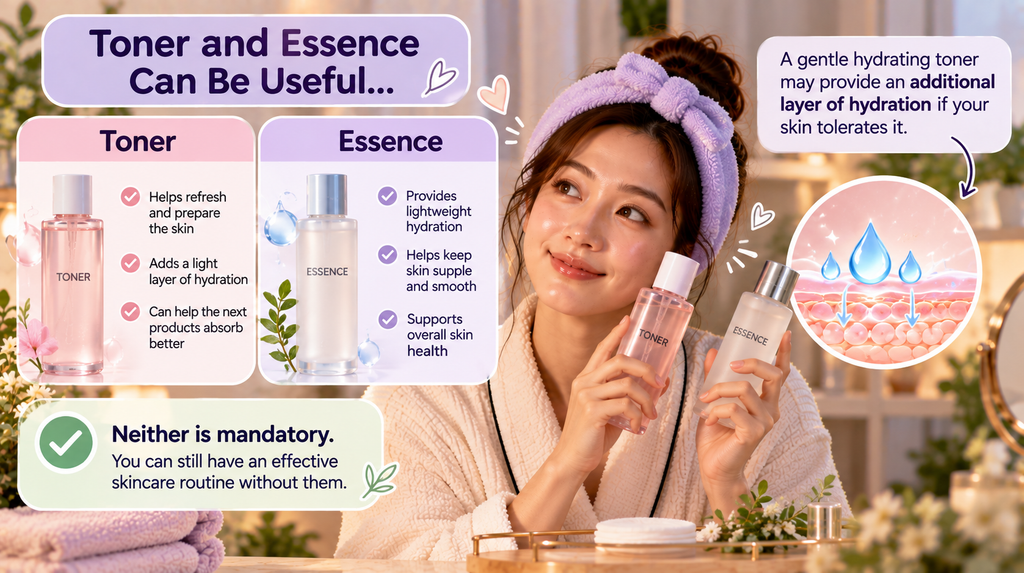
Potentially useful ingredients include:
- Glycerin
- Panthenol
- Beta-glucan
- Hyaluronic acid
- Allantoin
- Centella asiatica
But if your serum and moisturizer already provide enough hydration, you can skip toner. The same applies to essence.
** Don’t add a product simply because it appears in a traditional Korean skincare routine. Add it because it serves a useful purpose for your skin.
Step 3: Choose One Serum Or Ampoule
Sensitive skin doesn’t necessarily need a serum containing a long list of active ingredients. Instead, start with one clear purpose.
- If your skin feels irritated or stressed
Consider a soothing or barrier-focused formulation.
- If your skin feels dehydrated
Consider a hydrating serum.
- If uneven pigmentation is your concern
A suitable brightening treatment may be introduced gradually.
- If you’re concerned about visible signs of aging
Ingredients such as retinoids can be considered, but they aren’t the best place to start if your skin is already irritated.
The important principle is: Start with one treatment rather than layering several treatment products at once.
Is Centella Asiatica Good For Sensitive Skin?
Centella asiatica, often called cica, is widely used in Korean skincare products designed around soothing and skin comfort. One example is PURITO Wonder Releaf Centella Serum Unscented.
However, the presence of Centella doesn’t guarantee that a product will suit everyone. The complete formulation matters.
This is an important principle with sensitive skin: A “soothing” ingredient can be useful, but your skin still needs to tolerate the complete product.
Do You Need Both A Serum And An Ampoule?
No. The terms serum and ampoule aren’t standardized enough to determine that you need one of each. They can overlap considerably depending on their formulation and intended use.
For sensitive skin, you don’t need to build a routine like:
Toner → Essence → Serum → Ampoule
simply because those products exist. Start with one treatment product.
For example:
Cleanser → Centella serum → Moisturizer
may be all you need.
Step 4: Choose A Comfortable Moisturizer
Moisturizer is one of the most important products in a simple sensitive-skin routine. It helps maintain hydration and supports the skin barrier.
Ingredients commonly found in barrier-supporting or moisturizing formulations include:
- Ceramides
- Panthenol
- Glycerin
- Squalane
- Hyaluronic acid
- Fatty acids
- Cholesterol
- Other skin-conditioning ingredients
Your preferred texture may depend on your skin.
| Skin type | Possible texture |
|---|---|
| Dry sensitive skin | Richer cream |
| Oily sensitive skin | Lightweight gel-cream |
| Combination sensitive skin | Medium-weight moisturizer |
Don’t choose a moisturizer simply because the label says “night cream.” The formulation and how your skin responds are more important.
Why The Skin Barrier Matters
The skin barrier plays an important role in helping reduce excessive water loss and protecting the skin from external stressors.
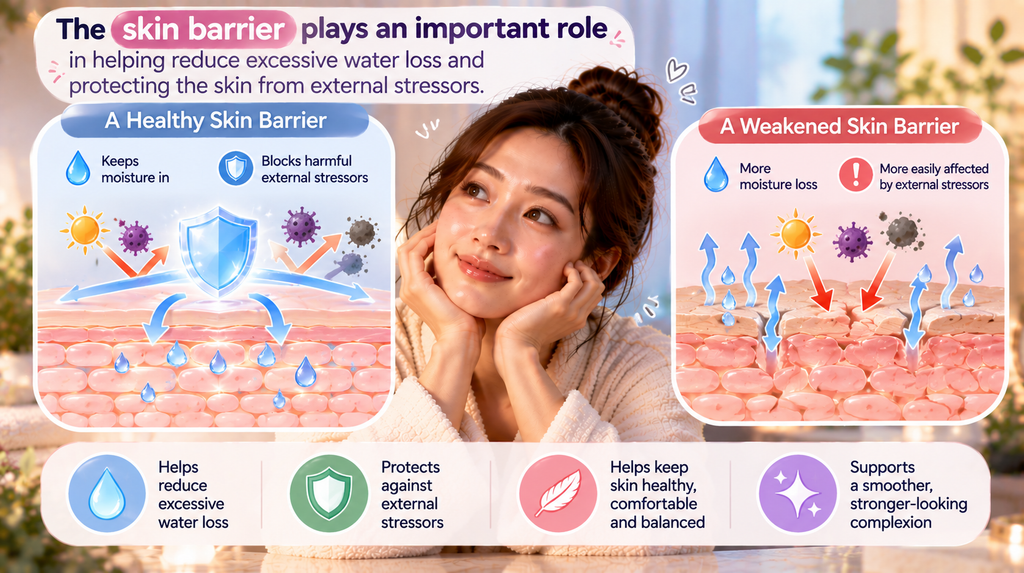
When skin is dry, tight, flaky or reactive, adding more active ingredients isn’t automatically the solution.
Sometimes the better approach is to temporarily simplify your routine:
Gentle cleanser → Moisturizer
Once your skin feels comfortable again, you can gradually reintroduce other products. This is particularly useful if you’ve been using many products and aren’t sure which one is causing a problem.
Do Sensitive Skin Types Need A Sleeping Mask?
No. A sleeping mask is an optional part of a nighttime routine.
If your moisturizer already keeps your skin comfortable overnight, adding another layer may not provide enough additional benefit to justify it.
If you do want to use one:
- Choose a formulation your skin tolerates
- Introduce it separately from other new products
- Follow the manufacturer’s instructions
- Don’t assume that thicker means better
Some sleeping masks are designed to go over moisturizer, while others can replace the moisturizer step.
For a more detailed comparison, see: Sleeping Mask vs. Night Cream: What’s The Difference And Which One Do You Need?
You can also read: How To Use A Korean Sleeping Mask: A Step-by-Step Night Routine
What About Fragrance And Essential Oils?
Some Korean skincare products contain:
- Fragrance
- Essential oils
- Botanical fragrance components
- Citrus oils
- Floral oils
These ingredients aren’t automatically problematic for everyone. However, if your skin is reactive, choosing a fragrance-free option may make your routine easier to control.
The important point isn’t to label every fragranced product as unsuitable. Instead, pay attention to your own skin’s response.
When your skin is sensitive, keeping the overall formulation simple can also make it easier to identify what your skin does and doesn’t tolerate.
What About Exfoliating Acids?
Sensitive skin doesn’t necessarily mean you must avoid exfoliation completely. But frequent or aggressive exfoliation may increase irritation.
Common exfoliating ingredients include:
- Glycolic acid
- Lactic acid
- Mandelic acid
- Salicylic acid
- PHAs such as gluconolactone
If you’re experiencing:
- Burning
- Stinging
- Increased redness
- Significant dryness
- Flaking
consider reducing or temporarily stopping exfoliation rather than adding more skincare.
You don’t need to exfoliate simply because your skin looks dull. Sometimes dullness can be related to dehydration or irritation.
What About Retinol And Retinoids?
Retinoids can be useful for concerns such as acne and visible signs of aging, but they can also cause irritation. If you’re new to retinoids, don’t introduce one alongside several other active products.
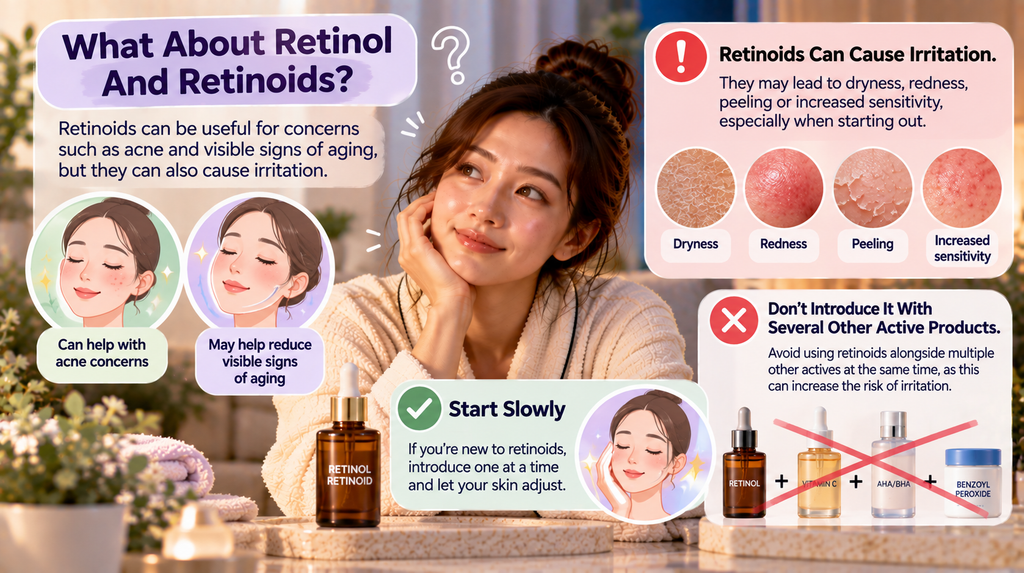
For example, avoid starting with a routine containing:
Retinoid + exfoliating acid + strong vitamin C + brightening serum + sleeping mask
Instead, introduce the retinoid as the main active and keep the rest of the routine simple.
A basic retinoid night could be:
Cleanser → Retinoid → Moisturizer
Depending on the product and your skin’s tolerance, another approach may be appropriate. Always follow the specific product instructions.
What About Vitamin C At Night?
Vitamin C can be used in the morning or evening depending on the formulation. It isn’t a mandatory part of a sensitive-skin nighttime routine.
If brightening or antioxidant care is a priority, you can consider introducing a suitable vitamin C product later, once your basic routine is stable and your skin is tolerating it.
Don’t Combine Too Many Actives
Sensitive skin doesn’t necessarily mean that you can never use active ingredients. The bigger issue is how many potentially irritating products you’re combining and how frequently you’re using them.
Be especially careful when your routine contains several of these:
- Retinoids
- AHAs
- BHAs
- Strong vitamin C
- Exfoliating enzymes
- High-concentration niacinamide
- Other potentially irritating actives
These ingredients aren’t automatically incompatible. The problem is that your skin may simply not need all of them at once. Multiple overlapping products can also make it difficult to determine which product is responsible if irritation develops.
Simple Sensitive-Skin Routines By Skin Type
- Dry Sensitive Skin
Gentle cleanser → Hydrating serum → Rich moisturizer
A sleeping mask can be added occasionally if additional overnight hydration is genuinely needed. Ingredients such as ceramides, panthenol, glycerin and squalane may be useful depending on the formulation.
- Oily Sensitive Skin
Gentle cleanser → Lightweight soothing serum → Gel moisturizer
Avoid aggressively stripping oil from the skin. Oily skin can still become dehydrated.
- Combination Sensitive Skin
Gentle cleanser → Soothing serum → Lightweight moisturizer
You can adjust the amount of moisturizer according to different areas of the face if necessary.
- Sensitive + Acne-Prone Skin
Gentle cleanser → Appropriate acne treatment → Moisturizer
Don’t automatically combine multiple acne treatments or exfoliating products. If acne is persistent, severe or causing significant discomfort, professional assessment may be appropriate.
Sometimes A Two-Product Routine Is Enough
Sensitive skin doesn’t always need a serum.
Sometimes:
Cleanser → Moisturizer
is a perfectly reasonable nighttime routine.
This can be particularly useful when:
- You’re just starting skincare
- Your skin is currently irritated
- You don’t know which product is causing a reaction
- You’ve been using too many products
- You want to establish a simple baseline
Once your skin is comfortable, you can decide whether another product is actually necessary.
A Simple Three-Step Routine
If you want a little more than the basic two-product routine, try:
Cleanser → Soothing or hydrating serum → Moisturizer
Each product has a clear job:
- Cleanser: Removes buildup
- Serum: Provides hydration or targeted soothing care
- Moisturizer: Helps maintain hydration and support the barrier
That’s enough. You don’t need additional products simply to make the routine look more “Korean.”
What About The Korean 10-Step Routine?
The famous Korean 10-step routine is better understood as a collection of possible skincare categories rather than a mandatory prescription.
A traditional multi-step routine might include:
- Oil cleanser
- Water-based cleanser
- Exfoliant
- Toner
- Essence
- Serum
- Sheet mask
- Eye cream
- Moisturizer
- Sleeping mask
But sensitive skin doesn’t automatically benefit from completing every step.
The right number of products is the number your skin needs and tolerates.
You can take the principles of Korean skincare including hydration, layering, consistency and attention to skin needs, without following every possible step.
6 Common Mistakes With Sensitive Skin
- Changing Everything At Once
Introducing five new products simultaneously makes it difficult to identify the cause if your skin reacts. Introduce products gradually. - Assuming “Korean” Means Gentle
Korean skincare includes both gentle products and highly active formulations. Always assess the actual product. - Using Too Many Soothing Products
You don’t need three different Centella products simply because your skin is sensitive. One suitable product may be enough. - Exfoliating Because Your Skin Looks Dull
Dullness isn’t always a sign that you need exfoliation. Dehydration and irritation can also affect how skin looks. - Using A Sleeping Mask To Compensate For An Unsuitable Moisturizer
If your moisturizer isn’t comfortable or hydrating enough, adding another product may not be the best solution. Sometimes the better answer is to find a moisturizer that suits your skin. - Chasing Every Trending Ingredient
You don’t need to collect PDRN, fermented ingredients, peptides, cica, snail mucin and every other trending ingredient at once. Choose products based on what your skin actually needs.
How To Introduce New Products
If your skin is sensitive, gradual introduction can make your routine much easier to manage.
- Start with the basics
Cleanser + Moisturizer
Give your skin time to settle.
- Add one treatment
If your skin is comfortable, introduce one hydrating or soothing serum.
Cleanser → Serum → Moisturizer
- Add another product only if necessary
If your skin remains comfortable and you have a clear reason for another product, introduce it separately. This approach makes it easier to identify which product is responsible if irritation occurs. If a product causes persistent or significant burning, swelling, rash or other concerning symptoms, stop using it and consider professional medical advice.
What About Patch Testing?
Patch testing can be useful before applying a new product broadly, particularly if your skin is reactive. Follow the manufacturer’s instructions where available.
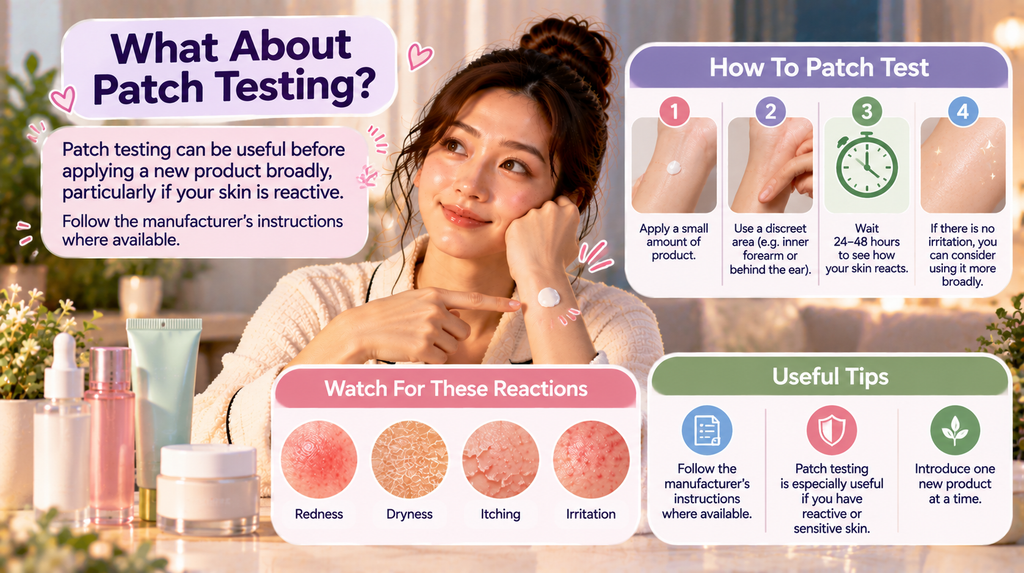
However, a small-area test cannot guarantee that a product will never cause irritation or an allergic reaction elsewhere. If you’ve previously experienced significant allergic reactions, professional guidance is preferable.
How To Simplify An Overwhelming Routine
If you’re already using eight or ten products and your skin isn’t happy, don’t replace everything at once.
Start by reducing the routine to:
Cleanser → Moisturizer
Once your skin is comfortable, consider adding:
Cleanser → Serum → Moisturizer
Only after that should you decide whether another product is genuinely necessary. This gives you a much clearer baseline.
A Simple Decision Guide
If you’re unsure what to remove or add, ask yourself:Is my skin currently irritated?
Answer: Yes → Simplify the routine.
Does my cleanser leave my skin feeling tight?
Answer: Yes → Consider a gentler cleanser.
Does my skin need more hydration?
Answer: Yes → Consider one hydrating or soothing serum.
Does my moisturizer feel comfortable?
Answer: Yes → Keep it.
Answer: No → Consider changing the moisturizer before adding another product.
Do I need toner?
Answer: Only if it provides useful hydration and your skin tolerates it.
Do I need a sleeping mask?
Answer: Only if there is a genuine reason for additional overnight hydration or treatment.
Do I need an exfoliant?
Answer: Not automatically.
Do I need multiple serums?
Answer: Usually not.
Korean Skincare Ingredients That May Be Useful For Sensitive Skin
Some ingredients commonly found in gentle or barrier-focused formulations include:
- Centella Asiatica
Commonly used in soothing and barrier-focused skincare.
- Panthenol
A moisturizing ingredient often used to support skin comfort.
- Ceramides
Important components of the skin barrier and commonly used in barrier-supporting products.
- Glycerin
A widely used humectant that helps support hydration.
- Hyaluronic Acid
A humectant used to attract and retain water.
- Beta-Glucan
Used in hydrating and soothing formulations.
- Squalane
An emollient that helps condition and soften the skin.
But don’t choose products simply because they contain a popular ingredient. The complete formulation matters more than any single ingredient.
For a deeper explanation of nighttime skincare ingredients, see: Korean Skincare Ingredients For Nighttime: What Do They Actually Do?
Does Sensitive Skin Need Korean Skincare Specifically?
No. Korean skincare can offer many useful formulations, but sensitive skin doesn’t specifically require Korean products.
When choosing skincare, consider:
- Formulation
- Ingredients
- Texture
- Frequency of use
- Your individual skin response
The label “Korean skincare” shouldn’t replace evaluating whether the product actually suits your skin.
Where Does A Sleeping Mask Fit?
If your skin tolerates it and you genuinely need additional overnight care, a sleeping mask can be placed toward the end of your routine.
For a product designed to go over moisturizer:
Cleanser → Hydrating/Soothing Treatment → Moisturizer → Sleeping Mask
However, some sleeping masks are designed to replace moisturizer. Always follow the specific product instructions.
For more information, see: