Korean Night Skincare: What Order Should You Apply Your Products?

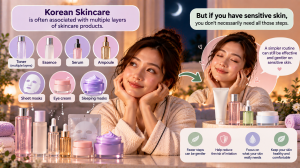
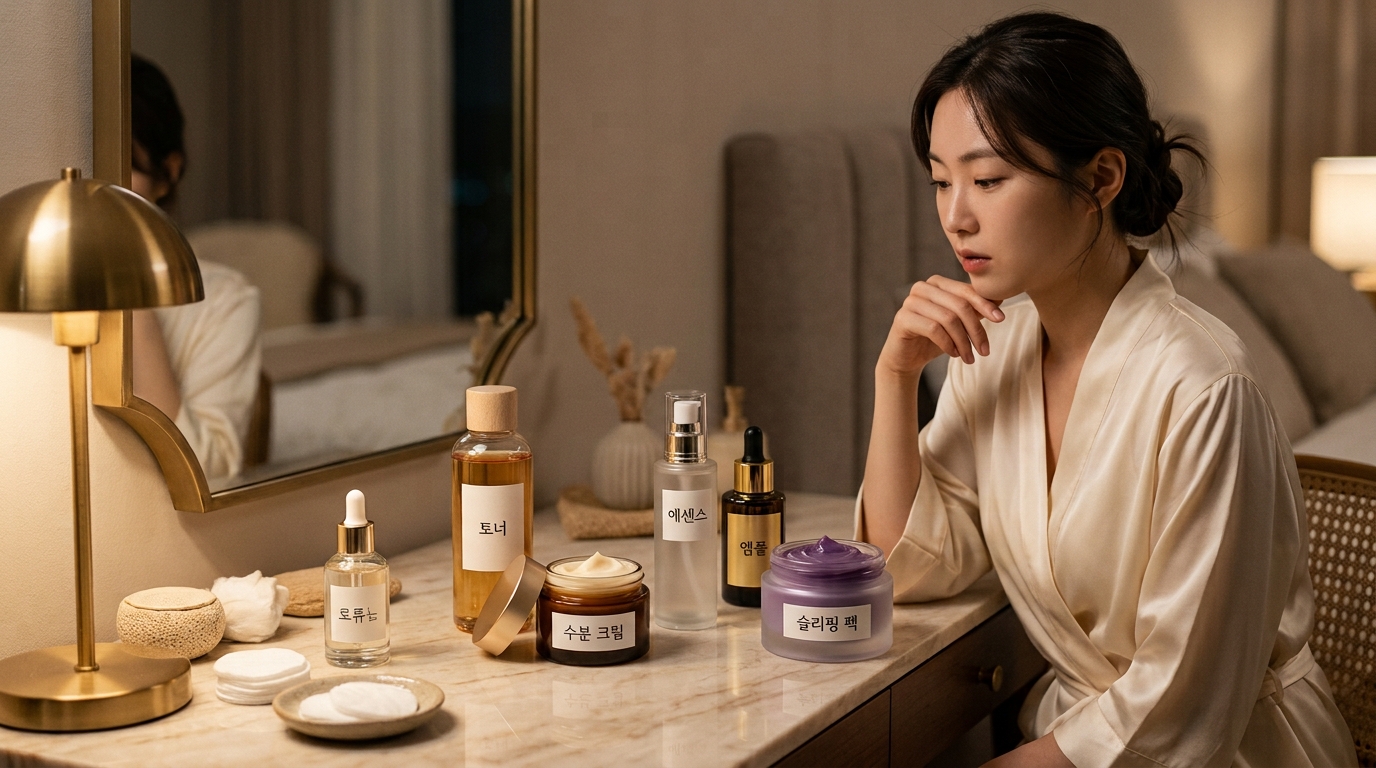
If you’ve ever looked at a Korean skincare routine and wondered whether your toner should go before your essence, where an ampoule fits, or whether a sleeping mask belongs before or after moisturizer, you’re not alone. Korean skincare routines can involve several layers, and the terminology doesn’t always make things easier.
You may have a cleanser, toner, essence, serum, ampoule, moisturizer, exfoliant, retinoid, and sleeping mask sitting on your shelf and suddenly a simple nighttime routine becomes a puzzle.
The most common advice is: Apply your skincare products from thinnest to thickest.
That’s a useful starting point, but it isn’t a universal rule.
The appropriate order can also depend on:
- What the product is designed to do
- Its texture and formulation
- Whether it contains an active ingredient
- How it interacts with other products
- The manufacturer’s instructions
- Your skin type and tolerance
- Whether you actually need every layer
The goal of skincare layering isn’t to follow a perfect sequence for the sake of it. It’s to apply products in an order that allows them to perform their intended function without unnecessarily irritating your skin.
This guide explains how to think about Korean nighttime skincare layering, where different products usually fit, when the usual order may need to change, and how to simplify everything when you only use a few products.
Why Does Skincare Order Matter?
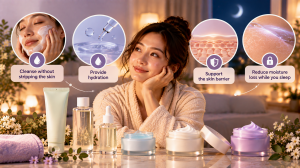
Skincare products are formulated for different purposes.
- A cleanser is designed to remove substances from the skin.
- A toner or essence may provide hydration and conditioning.
- A serum or ampoule may deliver targeted ingredients.
- A moisturizer helps maintain hydration and support the skin barrier.
- A sleeping mask may provide an additional overnight layer.
Applying these products in a sensible order makes the routine more practical and can help prevent heavier products from interfering with lighter products that are intended to be applied earlier.
For example, applying a heavy occlusive cream before a watery essence may make the essence more difficult to spread evenly. But this doesn’t mean that applying one product five minutes “out of order” will ruin your skincare routine. Skincare layering is a practical framework, not a chemistry exam.
The Basic Korean Night Skincare Layering Order
A useful general framework is:
Cleanser
↓
Toner or Essence
↓
Serum or Ampoule
↓
Moisturizer
↓
Sleeping Mask — Optional
This is a starting framework, not a mandatory checklist.
Exfoliating treatments and retinoids need to be incorporated according to the specific product and its instructions rather than simply being inserted into the sequence.
And you don’t need to use every category.
If you’re using only three products, your nighttime routine might simply be: Cleanser → Treatment → Moisturizer
That’s perfectly reasonable.
The “Thinnest to Thickest” Rule: Useful, But Not Absolute
The traditional skincare layering rule is:
Apply products from the thinnest texture to the thickest.
This works well as a starting point because lightweight, watery products generally spread more easily when applied before thicker creams.
For example:
Toner → Serum → Moisturizer
makes intuitive sense.
However, texture alone doesn’t determine the correct order.
Two products can have similar textures but completely different purposes. Some treatment products also have specific usage instructions that may take priority over a generic layering rule.
A manufacturer may recommend applying a product to clean, dry skin, using it before moisturizer, or limiting it to certain nights.
So rather than asking only:
“Which product is thinner?”
also ask:
“What is this product designed to do, and how does the manufacturer tell me to use it?”
That’s a much more reliable approach.
Step 1: Cleanser Comes First
Cleansing is normally the first skincare step because it removes substances that have accumulated on your skin throughout the day.
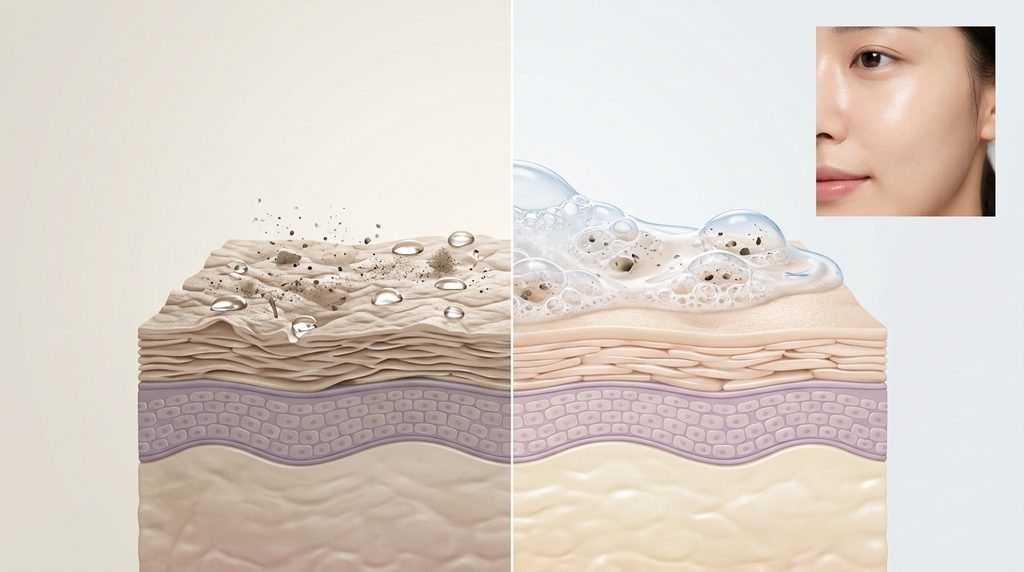
Depending on your routine, this may include:
- Makeup
- Sunscreen
- Excess oil
- Sweat
- Dirt
- Environmental residue
If you wear makeup or sunscreen, you may choose to double cleanse.
A typical double-cleansing sequence is:
Oil cleanser or cleansing balm → Water-based cleanser
The first cleanser helps remove oil-based products and residue, while the second cleanser cleanses the skin further. However, double cleansing isn’t automatically necessary for everyone every night.
The goal is to clean the skin appropriately without over-cleansing. Once your face is clean, you can move on to your leave-on skincare products.
Step 2: Toner — Does It Need To Come First?
Toner usually comes after cleansing. Modern Korean toners are often designed primarily to hydrate, condition, or prepare the skin rather than simply remove traces of cleanser.
A hydrating toner can therefore be a useful first leave-on layer. But there’s an important point: You don’t necessarily need a toner.
If your routine works perfectly well without one, there’s no requirement to add it simply because Korean skincare often includes one.
For example: Cleanser → Serum → Moisturizer
can be a perfectly functional routine.
Step 3: Essence — Does Essence Go Before Toner?
This is one of the more confusing questions in Korean skincare.
The short answer is: Usually, toner comes before essence but the actual formulation and product instructions matter more than the name on the bottle.
Toners are generally lightweight products, although their textures can vary considerably. Essences can range from very watery liquids to slightly viscous, more conditioning formulas.
Therefore, if you’re using both, a practical approach is usually: Toner → Essence
But don’t become overly concerned about whether you’ve followed the “correct” order if two products have almost identical textures.
What if the essence is more watery than the toner?
Then texture becomes relevant. You can generally apply the more watery product first, provided there aren’t specific product instructions saying otherwise.
The important thing to understand is that “toner” and “essence” aren’t standardized categories with identical textures across every Korean skincare brand.
Look at the actual product rather than relying solely on the label.
Toner vs. Essence: Do You Need Both?
Not necessarily. Both products can provide hydration and conditioning, and there can be significant overlap between their functions.
For a simple routine, choose whichever product provides a useful benefit for your skin.
For example:
Cleanser → Hydrating essence → Moisturizer
can work just as well as:
Cleanser → Hydrating toner → Moisturizer
You don’t need to use both merely to make your routine look more “Korean.”
Step 4: Where Do Serums And Ampoules Fit?
Serums and ampoules are usually applied after lighter hydrating layers.
A common sequence is:
Cleanser → Toner → Essence → Serum/Ampoule → Moisturizer
Serums and ampoules are often used to deliver more targeted skincare ingredients.
Depending on the product, they may focus on:
- Hydration
- Uneven-looking skin tone
- Skin texture
- Visible signs of aging
- Barrier support
- Soothing
Serum vs. Ampoule: Which Goes First?
There isn’t a universal rule saying that every serum must come before every ampoule. The terms serum and ampoule aren’t standardized enough to determine order by themselves.
If you’re using both, consider:
- Texture
- Intended function
- Active ingredients
- Product instructions
If one is noticeably lighter and more watery, it will generally be easier to apply first. If the manufacturer specifically recommends a particular order, follow that instruction.
What If You Have Several Serums?
This is where skincare layering can become unnecessarily complicated.
Suppose you have:
- A hydrating serum
- A niacinamide serum
- A peptide serum
Do you need to apply all three?
Not necessarily.
Layering multiple serums isn’t automatically more effective. Using too many leave-on products can also increase the likelihood of pilling, irritation, or simply making your routine unpleasant.
If you do use multiple treatment products, consider:
Texture → Function → Active ingredients → Instructions
rather than blindly following the order in which you purchased them.
More importantly, ask whether each product actually serves a distinct purpose.
Step 5: Where Does Moisturizer Go?
Moisturizer generally comes toward the end of your nighttime routine. It helps maintain hydration, reduce moisture loss, and support the skin barrier.
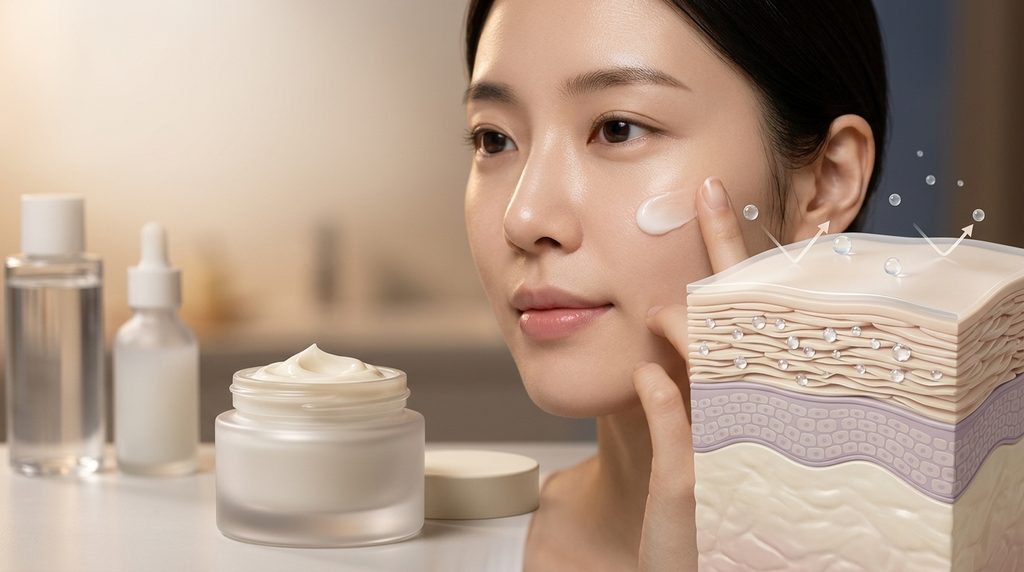
A typical sequence is:
Cleanser → Toner/Essence → Serum/Ampoule → Moisturizer
For many people, moisturizer is the final essential skincare step. Everything after it is optional and depends on the products being used.
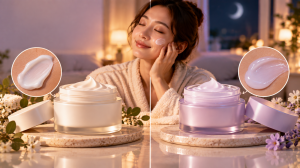
Moisturizer Before Or After A Sleeping Mask?
This is one situation where there isn’t a universal answer.
A sleeping mask is usually applied toward the end of the nighttime routine, but whether it goes over moisturizer or instead of moisturizer depends on the formulation.
If the sleeping mask is designed as the final layer
You may use:
Cleanser → Toner → Serum → Moisturizer → Sleeping Mask
If the sleeping mask is designed to replace moisturizer
You may use:
Cleanser → Toner → Serum → Sleeping Mask
Some sleeping masks are specifically formulated to function as the final moisturizing step. Others are designed to be used over your existing skincare. Always check the product’s instructions. For a detailed guide specifically about sleeping-mask application, see [How to Use a Korean Sleeping Mask: A Step-by-Step Night Routine].
Where Do Exfoliating Acids Fit?
Exfoliating acids such as AHAs, BHAs, and PHAs can complicate a nighttime routine because they aren’t simply another hydration layer. They’re treatment products.
Depending on the formulation, an exfoliating product may be used after cleansing and before other leave-on products.
For example:
Cleanser → Exfoliant → Hydrating/Treatment Products → Moisturizer
But this isn’t universal. Some exfoliating products are designed to be used differently, so follow the manufacturer’s directions.
Don’t automatically layer every active
If you’re using an exfoliating acid, you don’t necessarily need several other strong actives on the same night. For beginners, alternating treatments can be a simpler approach.
For example:
- Night A: Exfoliating treatment
- Night B: Hydration and barrier support
- Night C: Exfoliating treatment
The exact frequency should depend on the product and your skin’s tolerance.
Where Do Retinoids Fit?
Retinoids are another example of why skincare order can’t be reduced to “thin before thick.” A retinoid is a treatment product, and its instructions may specify when and how it should be applied.
A simplified routine might look like:
Cleanser → Retinoid → Moisturizer
or:
Cleanser → Hydrating layer → Retinoid → Moisturizer
depending on the product and your skin’s tolerance.
Some people use moisturizer before and/or after a retinoid to make the routine more comfortable. This approach is sometimes referred to as buffering. The appropriate approach depends on the specific retinoid, formulation, and your skin.
One important rule
“Don’t introduce a retinoid at the same time as several other strong active ingredients if you’re new to them. If irritation occurs, you’ll have a much harder time identifying which product may be responsible.”
What Happens If You Don’t Follow The Perfect Order?
Probably less than you think. If you accidentally apply your essence after your serum one night, you haven’t ruined your skin. Skincare layering isn’t so fragile that a small ordering mistake automatically makes every product ineffective.
Order becomes more important when:
- A product needs to be applied to clean skin
- A treatment has specific application instructions
- One product is particularly occlusive
- Multiple active ingredients are involved
- Products are pilling
- Your skin becomes irritated
- The manufacturer specifies a particular sequence
Otherwise, small differences in layering order are unlikely to make or break your entire routine. Consistency and appropriate product selection are more important than achieving a theoretically perfect sequence every night.
How Long Should You Wait Between Skincare Layers?
You generally don’t need to wait several minutes between every product. For most routine steps, you can apply the next product once the previous one has spread evenly and settled enough that you’re not simply moving it around your face. This might take only a few seconds.
When might you wait longer?
You may want to give a product more time to settle if:
- It feels very wet or slippery
- The next product tends to pill over it
- You’re applying a treatment with specific instructions
- You’re using several layers and want to avoid excessive rubbing
There is no universal “five-minute rule” for every skincare product.
If a product’s instructions specify a waiting period, follow those instructions. Otherwise, you don’t need to sit beside your bathroom mirror with a stopwatch.
What If A Product Has Unusual Instructions?
This is where the manufacturer’s directions take priority over generic skincare rules.
For example, a product might say:
- Apply to completely dry skin
- Apply immediately after cleansing
- Use before moisturizer
- Use as the final step
- Rinse after a certain period
- Use only two or three times per week
- Apply only at night
If the instructions conflict with the general “thinnest to thickest” rule: Follow the product instructions.
The generic layering rule is a guideline. The formulation-specific instructions are more relevant to that particular product.
What If A Product Is Very Thick but Needs To Go Earlier?
This is another reason texture isn’t the only consideration. Some treatment products have unusual textures. A thicker product might have specific application instructions because of its active ingredients or formulation.
In that situation, don’t rearrange the product simply because it doesn’t fit neatly into a thinnest-to-thickest sequence. Instead, follow the intended usage instructions.
This is particularly important for:
- Exfoliating treatments
- Retinoids
- Acne treatments
- Prescription products
- Products requiring application to clean, dry skin
How To Simplify Your Routine When You Only Have 2–3 Products
You don’t need a seven-step routine to benefit from Korean skincare. If you have only three products, you can keep it extremely simple.
Three-Product Routine
- Cleanser
- Treatment product
- Moisturizer
For example:
Cleanser → Niacinamide serum → Moisturizer
Or:
Cleanser → Hydrating serum → Moisturizer
That’s enough to establish a straightforward nighttime routine. If you want to understand how to build a complete beginner routine rather than focusing specifically on layering, see [Korean Night Skincare Routine for Beginners: A Simple Step-by-Step Guide].
A Simple Korean Night Skincare Layering Chart
Here’s a practical reference you can save:
| Product | Usual position |
|---|---|
| Makeup remover | Before cleanser |
| Oil cleanser/balm | First cleanse |
| Water-based cleanser | After oil cleanser |
| Toner | After cleansing |
| Essence | After toner, if used |
| Serum | After lighter hydration layers |
| Ampoule | Usually around the serum stage |
| Exfoliating treatment | According to product instructions |
| Retinoid | According to product instructions |
| Moisturizer | Toward the end |
| Sleeping mask | Usually the final step, if required |
| Face oil | Often near the end, depending on formulation |
The word “usual” is important. This isn’t a rigid prescription. Always consider the specific product instructions.
How To Layer Products For Different Skin Types
Your skin type doesn’t necessarily change the fundamental order, but it can change how many layers you actually need.
- Oily Skin
A simple routine may be:
Cleanser → Lightweight serum → Lightweight moisturizer
You may not need several hydrating layers. If your skin feels comfortable with a single serum and moisturizer, there’s no reason to add three more products.
- Dry Skin
A more layered routine might be:
Cleanser → Hydrating toner → Essence → Serum → Moisturizer
A sleeping mask can be added when appropriate. The objective isn’t simply to add more products. It’s to provide enough hydration and barrier support for your skin to remain comfortable.
- Combination Skin
You can keep the overall routine simple and adjust product quantity or texture according to different areas. For example, you might use a lightweight moisturizer across the face and apply a richer layer only where your skin tends to feel dry.
- Sensitive Skin
Keep the layering minimal.
For example: Gentle cleanser → Simple moisturizer
Then add one product at a time if needed. A shorter routine also makes it easier to identify which product may be causing irritation.
How To Layer Multiple Active Ingredients
This is where caution becomes more important.
A routine containing several products can look impressive on paper:
Vitamin C + Niacinamide + AHA + BHA + Retinoid + Peptides + Sleeping Mask
But that doesn’t mean it is a good routine. Several active ingredients may overlap in function or increase the likelihood of irritation when combined.
Instead of asking:
“Can I technically use these ingredients together?”
also ask:
“Do I actually need to use them together?”
That distinction can make your routine much easier to manage.
A Practical Approach
Consider assigning different active ingredients to different nights.
For example:
- Monday: Retinoid
- Tuesday: Hydration and barrier support
- Wednesday: Exfoliating treatment
- Thursday: Hydration and barrier support
- Friday: Retinoid
- Saturday: Hydration
- Sunday: Simple recovery routine
**This is only an example framework, not a universal schedule. Your actual frequency should depend on the products you’re using and how your skin responds.
Common Korean Skincare Layering Mistakes
- Mistake 1: Following “Thinnest to Thickest” Blindly
It’s a useful rule, but not the only rule. Product instructions, formulation, and active ingredients matter too.
- Mistake 2: Using Every Product You Own
Having eight products doesn’t mean you need to layer all eight every night. Use products because they serve a purpose.
- Mistake 3: Confusing Product Names With Functions
A serum isn’t necessarily always lighter than an ampoule. An essence isn’t always thinner than a toner. Product names aren’t standardized enough to determine order by themselves.
- Mistake 4: Applying Too Much
Excess product can increase the likelihood of pilling and make your routine uncomfortable. More isn’t automatically better.
- Mistake 5: Rubbing Every Layer Aggressively
Repeated rubbing can make skincare feel irritating, particularly if your skin is already sensitive. Apply products gently and allow them to settle.
- Mistake 6: Introducing Multiple Actives At Once
If irritation occurs, you won’t know which product caused it. Introduce active products gradually.
- Mistake 7: Ignoring Product Instructions
Generic skincare advice cannot account for every formulation. When the label provides specific instructions, pay attention to them.
Why Does Skincare Sometimes Pill?
Pilling happens when skincare products form small balls or flakes on the surface instead of remaining smooth.
It can happen for several reasons, including:
- Applying too much product
- Rubbing too aggressively
- Layering certain textures together
- Not allowing a product to settle
- Applying many layers
- Particular formulation combinations
If your skincare keeps pilling, don’t automatically assume that you need to wait ten minutes between every layer. Try reducing the amount of product first. You can also simplify the routine and see whether the problem disappears.
Does Applying More Layers Mean More Hydration?
Not necessarily. There is a point where additional layers may provide diminishing returns.
For example, someone with dry skin may benefit from: Hydrating toner → Serum → Moisturizer
But adding several more essences and multiple sleeping masks may simply make the routine heavier. Your skin doesn’t need to be covered in products to be adequately hydrated. Pay attention to how your skin feels rather than counting the number of layers.
What About Facial Oils?
Facial oils are often applied toward the end of a routine because they tend to be more occlusive than watery products.
A simplified sequence might be: Cleanser → Hydrating serum → Moisturizer → Face oil
But this can vary depending on the formulation. Some facial oils are designed to be mixed with moisturizer or used in a different way. Again, the product’s instructions take priority.
What About Eye Cream?
Eye creams are another category where people can become overly concerned about exact placement. If you’re using one, it is commonly applied after lighter treatment products and before or around the moisturizer stage.
However, you don’t necessarily need a separate eye cream simply because it is part of a traditional multi-step routine. If your existing moisturizer is appropriate for the area around your eyes and you’re comfortable using it there, you may not need another product.
What About Sheet Masks?
Sheet masks don’t necessarily belong in your routine every night.
When you use one, it is generally incorporated after cleansing and before heavier leave-on products, although the instructions for the particular mask should take priority.
A common sequence might be: Cleanser → Toner → Sheet Mask → Serum → Moisturizer
However, follow the instructions for the specific mask.
The same principle applies to wash-off masks. They need to be used at the stage where they can actually perform their intended function rather than simply being inserted into a generic sequence.
A Practical Way To Decide Product Order
When you’re unsure where a product belongs, work through these questions:
- Does it need to be rinsed off?
If yes, it generally belongs before leave-on skincare. - Is it designed to be applied to clean skin?
If yes, follow that instruction. - Is it a lightweight hydration product?
It will generally fit toward the beginning of your leave-on routine. - Is it a targeted treatment?
Consider its active ingredients and specific instructions. - Is it a moisturizer or more occlusive product?
It will generally go toward the end. - Is it a sleeping mask?
Usually near the end, but check whether it replaces or goes over moisturizer. - Does the manufacturer specify an unusual order?
Follow the manufacturer’s instructions. This method is much more useful than trying to memorize a list of ten steps.
The Perfect Order Isn’t The Point
Skincare layering advice can make nighttime skincare seem much more complicated than it really is. The truth is that there isn’t one universal sequence that works identically for every Korean skincare product.
A useful starting point is:
Cleanse → Hydrate → Treat → Moisturize → Seal, if appropriate. But within that framework, the details depend on the individual products.
- Toner and essence may overlap.
- Serum and ampoule terminology varies.
- Sleeping masks may replace moisturizer or be applied over it.
- Exfoliants and retinoids have their own considerations.
And some products come with instructions that don’t fit neatly into the traditional “thinnest to thickest” model. Understanding why you’re applying something is more valuable than memorizing exactly where it belongs.
Frequently Asked Questions
- Should Korean skincare always be applied from thinnest to thickest?
No. Thinnest to thickest is a useful general guideline, particularly for ordinary hydrating products, but it isn’t a universal rule. Product function, active ingredients, formulation, and manufacturer instructions can all affect the appropriate order. - Does toner go before essence?
Usually, yes. However, the actual texture and formulation matter more than the product name. If you’re using both, the lighter, more watery product will generally be easier to apply first, unless the product instructions specify otherwise. - Does serum go before ampoule?
Not necessarily. “Serum” and “ampoule” aren’t standardized categories. Compare their texture, ingredients, intended function, and product instructions. - Should moisturizer go before a sleeping mask?
Usually, a sleeping mask is applied at the end of the routine, but whether it goes over moisturizer or replaces it depends on the product. Check the manufacturer’s instructions. - How long should I wait between skincare products?
Usually, you only need to wait long enough for the previous product to spread and settle. There is no universal requirement to wait several minutes between every layer. - Can I use several serums at once?
You can, but you don’t necessarily need to. Multiple serums can increase complexity, pilling, or irritation. Consider whether each product has a distinct purpose and whether your skin actually needs all of them. - What should I do if my skincare pills?
Try using less product, reducing the number of layers, and applying each product gently rather than rubbing aggressively. You can also experiment with the order of products based on their texture and instructions. - Do I need a toner, essence, serum, ampoule, and sleeping mask?
No. A simple routine can be completely adequate: Cleanser → Treatment → Moisturizer. Additional products should have a clear purpose rather than being added simply because they are associated with Korean skincare.
Final Thoughts
The biggest mistake with Korean skincare layering is treating the routine as a rigid sequence that must be memorized perfectly. The thinnest-to-thickest principle is useful, but it’s only the starting point.
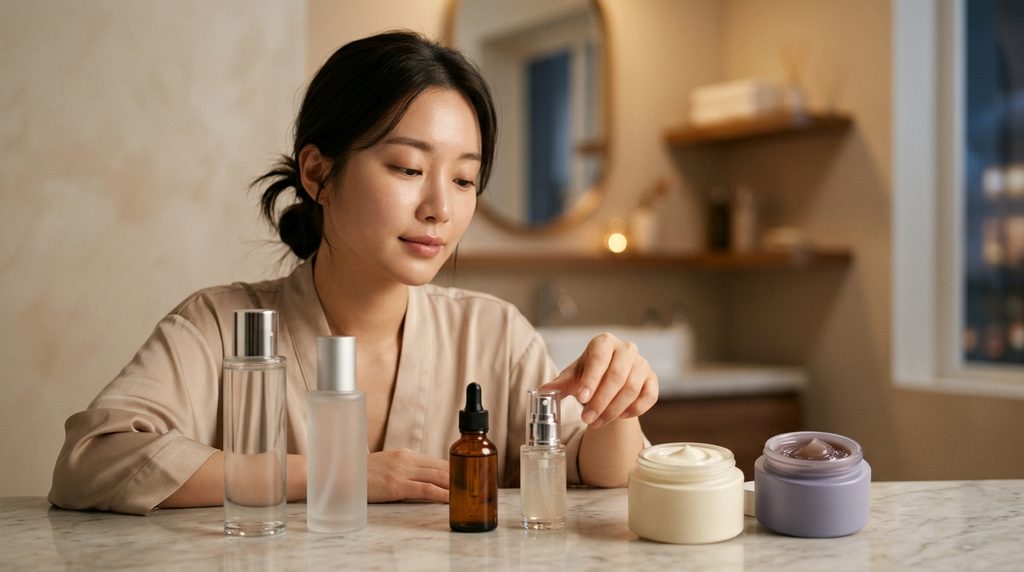
A better approach is to consider four things:
- Texture.
- Function.
- Active ingredients.
- Product instructions.
From there, the general structure becomes much easier:
Cleanse → Lightweight hydration → Treatment → Moisturize → Optional final layer
You don’t need ten products. You don’t need to wait five minutes between every step. And you don’t need to panic if your toner and essence occasionally end up in the “wrong” order.
Build your routine around what your products are actually designed to do, keep the number of layers manageable, and pay attention to how your skin responds.
That is far more useful than chasing a supposedly perfect Korean skincare sequence.